
Lift Modernisation Jobs: Quotes, Change Orders, Sign-Off
Lift Modernisation and Major Repair Jobs: Quotes, Change Orders and Sign-Off
By Mr. Sumeet Katariya, ElevatorPlus ·
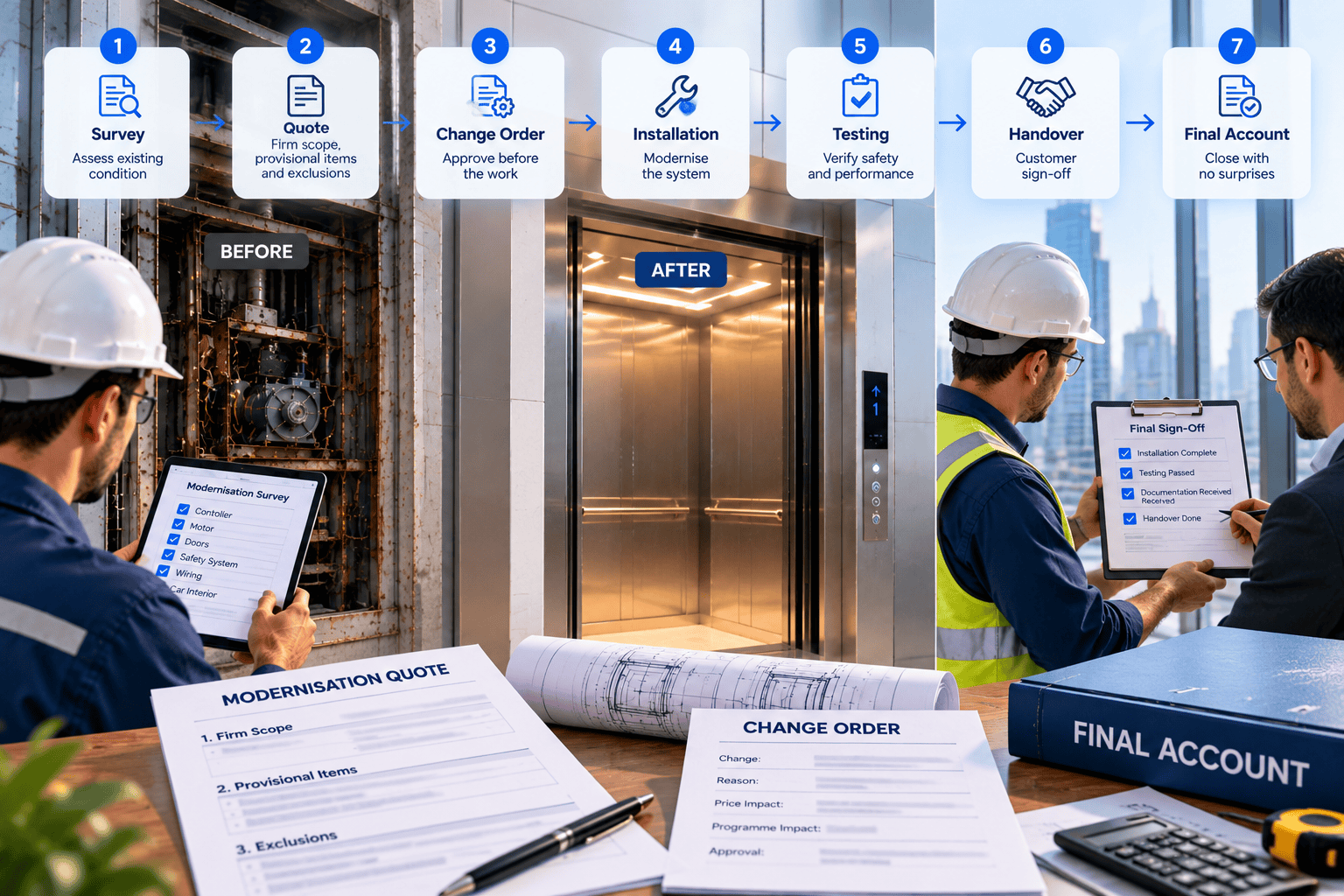
In short: Lift modernisation project management goes wrong in three places: a quote that mixes firm scope with work nobody can see yet, scope changes carried out before anyone approved them, and sign-offs nobody collected. Fix it with a quote in three parts (firm scope, provisional items, exclusions), a written change order approved before the labour is spent, and a signed record at seven stages from survey to final account. In the US the job is called elevator modernization. The paperwork is the same.
Key takeaways
- A modernisation quote needs three parts, not one total. Firm scope, provisional items priced one by one, and exclusions in writing. A single number invites a single argument.
- Most margin is lost after the quote is accepted. Hidden defects found once the old equipment is out, extras the customer asks for on site, and days lost waiting on the building's own work.
- A change order is only worth something if it was approved before the work. Afterwards it is a request for money the customer never agreed to.
- Seven sign-offs cover the whole job. Survey, quote acceptance, shutdown date, site readiness, testing, handover and final account.
- The final account should hold no surprises. It is the accepted quote, plus approved change orders, minus provisional items not used. Nothing else.
What this guide covers: why modernisation jobs lose money · how to structure the quote · what counts as a change order · the seven sign-offs · notes for the US and India · the final account · how ElevatorPlus handles it · FAQs
Why does lift modernisation project management lose money after the quote is accepted?
Because a modernisation is priced before anyone has seen inside the equipment. The quote is accepted on what the surveyor could see. The job is carried out on what is actually there, often in a lift with decades of repairs inside it. Margin goes in three ways:
- Hidden scope. Worn components, undocumented wiring or a machine room that is not what the drawings show. Found once the old equipment is out.
- Customer extras. A new car finish, an extra landing indicator, a change to the door. Asked for on site, done as a favour, never billed.
- Waiting time. Your team ready, the building's own work not done: power, access, builder's work in the shaft or machine room.
A major repair, such as a controller replacement or a door rebuild, has the same shape at a smaller size.
For what your software needs to do across service, AMC and projects, see What Is Elevator Service Software? A Straight Answer for Lift Companies. For winning modernisation work in the first place, see Elevator Modernisation UK 2026: Building Retrofit Pipelines. This guide is about running the job once you have it.
How should a lift modernisation quote be structured?
In three core parts (firm scope, provisional items and exclusions) plus four supporting sections, all signed with the acceptance. The point is that when something changes, everyone can see which part it belongs to.
| Part | What goes in it | Why it matters |
|---|---|---|
| Firm scope | Every item you will supply and fit at a fixed price | The customer knows exactly what the base price buys |
| Provisional items | Work you expect may be needed but cannot confirm until the equipment is opened, each priced separately | Hidden scope already has a price, so finding it is not a dispute |
| Exclusions | Work you are not doing, named one by one | Removes the "we assumed that was included" conversation |
| Customer obligations | Power supply, access, builder's work, clearing the machine room, notice to occupants | Waiting time has a cause written down before it happens |
| Programme | Survey, shutdown date, expected return to service | Gives every later date something to be measured against |
| Payment milestones | Named stages, such as acceptance, material delivery, return to service and final account | Ties cash to progress the customer can see |
| Validity | How long the price holds | Protects you when material prices move |
Price each provisional item separately, and state that none is carried out until the customer approves it in writing. That turns each one into a pre-priced change order.
Name the milestones rather than fixing percentages in a template. The split depends on your contracts and your customer.
What counts as a change order on a modernisation job?
Anything that changes the scope, price or programme after the quote was accepted.
| What happened | Example | Change order? |
|---|---|---|
| Customer asks for something extra | Different car finish, extra indicator, upgraded door | Yes |
| Provisional item confirmed once opened | A component listed as provisional turns out to need replacing | Yes, at the price already quoted |
| Hidden defect not listed as provisional | Something nobody could have seen at survey | Yes, priced and approved before the work |
| Customer's own work is late | Power or builder's work not ready on the agreed date | Yes, where the contract provides for it |
| Customer removes an item | Decides to keep the existing finish | Yes, as a credit |
| Your own error | Wrong part ordered | No. That cost is yours |
The last row matters. Bill your own mistakes once and the customer doubts every legitimate change after it.
What goes into a change order?
A short document that anyone can understand a year later without the email thread.
| Field | What to write |
|---|---|
| Reference | The original quote or contract number |
| Change | What is being added, removed or altered |
| Reason | Customer request, provisional item confirmed, hidden defect, or delay by others |
| Price impact | The amount added or credited |
| Programme impact | Days added to the return-to-service date, if any |
| Milestone impact | Which payment milestone it is billed with |
| Requested by | Name on the customer side |
| Approved by | Customer signature and date |
The rule that protects the margin
Approve before the labour is spent. Once your mechanics or technicians have done the work, the change order is no longer an agreement. It is a request for money, and the customer can say no.
This is hard on site. The team is there and the building wants the lift back. So the approval has to be fast: sent to the right person's phone and signed the same day. A process that needs a printed form and a meeting will be skipped.
👉 How many scope changes on your last modernisation were done before anyone signed? See how change orders are raised, approved and signed in ElevatorPlus →
Which sign-offs should you collect, and when?
Seven. Each closes a stage, so a dispute about one cannot reopen the others.
| Stage | What is signed | Who signs | What it protects |
|---|---|---|---|
| 1. Survey | Survey findings and photos | Your surveyor, customer representative | What the lift looked like before you touched it |
| 2. Quote acceptance | Firm scope, provisional items, exclusions, milestones | Customer | The baseline every change is measured against |
| 3. Shutdown date | Date the lift goes out of service, and notice to occupants | Customer | Who told the building, and when |
| 4. Site readiness | Customer obligations complete: power, access, builder's work | Customer, your site lead | Waiting time is the customer's, not yours, if this is late |
| 5. Testing | Tests carried out and results | Your engineer | The lift worked when you finished |
| 6. Handover | Return to service, handover documents, keys, any snag list | Customer | The date the lift became theirs again |
| 7. Final account | Quote, plus approved change orders, minus unused provisional items | Customer | The last number, agreed once |
Stages 1 and 6 should carry photos. A machine room photo from survey day settles more arguments than any clause.
A note for US elevator modernisation jobs
In the US, permit and inspection steps for an elevator modernization depend on your jurisdiction. Where your AHJ requires an acceptance inspection before the unit returns to service, it sits between testing and handover, so check those requirements before you commit to a return-to-service date. After handover, set up the unit record and checklist for the new equipment before the first visit under the maintenance agreement.
A note for lift modernisation in India
In India, what has to happen with the state authority before and after a modernisation depends on the state. Each state has its own lift Act and Rules, and some states have none in force. Check your state's lift Act and Rules before you quote the programme, and see Lift Rules by State in India: What 15 States Actually Require (2026) for where each state stands.
After handover, the modernised lift should join your AMC book on day one, with its AMC start and end dates set. A lift you have just rebuilt is the easiest AMC you will ever sell.
How do you keep the final account from becoming a dispute?
By making it arithmetic. If every change went through a signed change order, the final account is a sum, not a negotiation.
| Line | Source |
|---|---|
| Accepted quote, firm scope | Stage 2 sign-off |
| Add: approved change orders | Each signed change order |
| Add: provisional items used | Each approved provisional item |
| Less: provisional items not used | Quote, less those approved |
| Less: credits for removed items | Signed change orders |
| Final account | The total, signed at stage 7 |
| Less: payments received | Your payment log |
| Balance due | The last invoice |
If a line cannot be traced to a signed document, it will be argued. Raise it separately, or accept that it is lost. Record every payment against the job as it arrives, with the next milestone due.
How does ElevatorPlus handle quotes, change orders and sign-off?
| Step | What ElevatorPlus does |
|---|---|
| Quotation | We rebuild your existing quotation format during onboarding. You can have more than one format, for example by lift type and by branch. Multi-currency quotations are available in the mobile app. |
| Internal approval | Approval workflows route quotations by amount, designation or branch, with multi-level approval and approval from a phone. |
| Change orders | A change order references the original document, sets out the new scope and the price impact, and goes to the customer for digital signature by WhatsApp or email. Approved change orders update the project budget. Each project lists its change orders as pending, approved or rejected, with amount, date and approver. |
| Signed documents | Modernization agreements, change order documents and handover acceptance documents can be signed digitally. You can see which are sent, opened, signed or pending, and signed documents are stored in the client record. |
| Project tracking | Project management shows planned dates against actual progress on a Gantt chart, with site photos and remarks, delay escalations and auto-generated handover letters. |
| Payments | Log every payment received and the next due date. ElevatorPlus reminds your team when a collection follow-up is due. The invoice itself stays in whatever invoicing software you already use. |
| After handover | The lift moves onto its maintenance contract, with renewal reminders 60 days, 30 days and 1 day before expiry. |
ElevatorPlus is not an accounting platform. Most customers are fully live within 2 to 7 days, with data migration, configuration and team training included.
Frequently asked questions
1. How should a lift modernisation quote be structured?
In parts: firm scope at a fixed price, provisional items priced one by one, named exclusions, customer obligations, a programme, named payment milestones and a validity period.
2. What is a change order on a modernisation job?
A signed document that changes the scope, price or programme after the quote was accepted. It references the original quote and states the reason, the price impact and the time impact.
3. When should a change order be approved?
Before the work is done. Once the labour is spent, the change order becomes a request for payment that the customer never agreed to.
4. What are provisional items in a modernisation quote?
Work you expect may be needed but cannot confirm until the old equipment is opened. Each is priced separately and carried out only after the customer approves it in writing.
5. Which sign-offs should a modernisation job have?
Seven: survey, quote acceptance, shutdown date, site readiness, testing, handover and final account. Survey and handover should carry photos.
6. How do you avoid disputes over the final account?
Make it arithmetic: the accepted quote, plus approved change orders and provisional items used, minus unused provisional items and credits. Anything without a signed document goes on a separate line.
7. Can ElevatorPlus send change orders for customer signature?
Yes. A change order references the original document and goes to the customer for digital signature by WhatsApp or email. Approved change orders update the project budget.
📲 Join our WhatsApp channel for compliance tips, updates: ElevatorPlus - Business Automation Tool
Modernisation margin is rarely lost on the price. It is lost in the weeks after the quote is accepted, one small favour and one unsigned extra at a time.
The fix is not more paperwork. It is the right paperwork at the right moment: provisional items priced up front, a change order signed before the work, and a signature at each of the seven stages.
Make the signature fast, on a phone, the same day, and site teams stop resisting it. Then the final account stops being a negotiation and becomes a sum.
👉 Find out where your modernisation jobs are leaking margin. Book the Revenue Leak Walk-Through →
Related reading
- Elevator Estimating and Quotation Software (2026 Guide)
- Elevator Modernisation UK 2026: Building Retrofit Pipelines
- Gulf Lift Installation: Contract Award to Handover
- Lift Rules by State in India: What 15 States Actually Require (2026)
- The Clauses That Decide Whether a Lift AMC Makes Money
About the author. Mr. Sumeet Katariya is the founder of ElevatorPlus, the Elevator Business Operating System used by 200+ elevator companies across 20+ countries.
Sources: State lift Acts and Rules as read by ElevatorPlus, September 2026. · Drawn from ElevatorPlus onboarding work with 200+ elevator companies across 20+ countries.
👉 Follow ElevatorPlus on,
Instagram LinkedIn Facebook YouTube Qoura Substack Twitter