
Powering Elevator Businesses Worldwide
Trusted by Fastest-Growing Elevator Companies
Elevator companies do not usually lose money on the parts they buy. They lose it on the parts they cannot account for. A door operator issued to a site nobody recorded, a controller card in someone's van since March, a rope ordered twice because the first one could not be found.
In ElevatorPlus nothing leaves a warehouse without a delivery challan. Every dispatch is documented, the stock deducts against it, and the cost books to the job or contract it was issued for. That applies whether the customer is paying for the part or it is covered under a comprehensive AMC. What is left on the shelf is what the system says is left.
Trusted by Fastest-Growing Elevator Companies
A part is taken from the store for a job. The person who took it meant to write it in the register and did not, or wrote it in a register that has since been replaced. The stock figure and the shelf stopped agreeing that day.
Technicians carry stock, and they should. But van stock that is not tracked is stock that has left your books without leaving your business. It reappears at the next audit, or it does not.
Somebody could not find a part that was in a different branch store, so they ordered another one. Both are now in stock, in different cities, and neither is on the job that needed it.
Dead stock accumulates quietly. A controller for a lift model you no longer service, a batch of the wrong door shoes, safety gear that has been on the shelf for four years. It is money, and it is sitting still.
The system does not need anybody to maintain it separately. It updates because the ordinary work of the business flows through it.
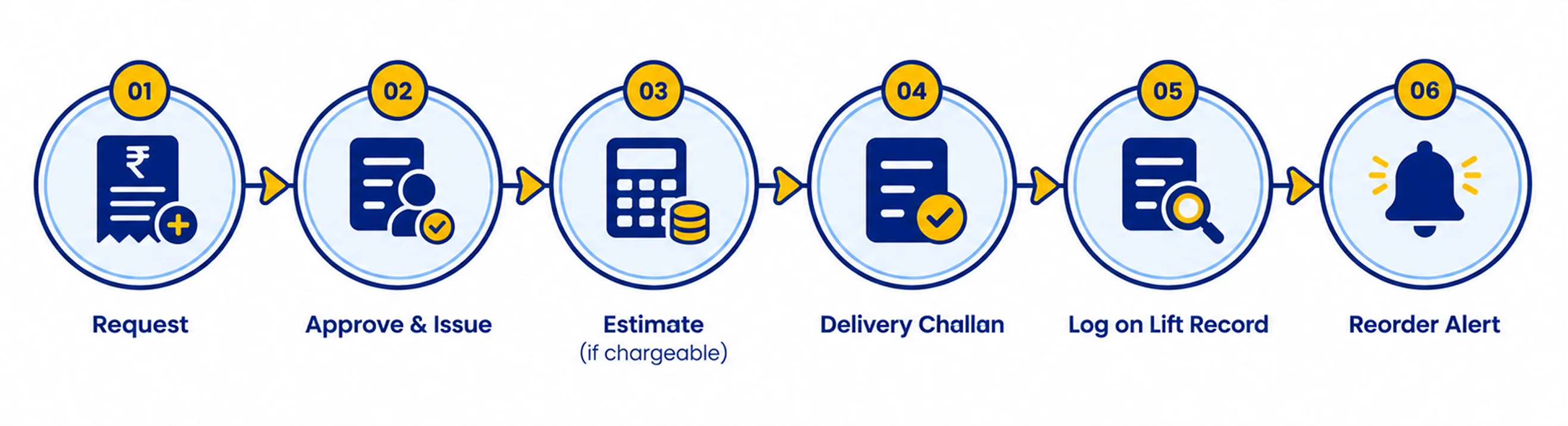
From the app, against the job he is working on. The request arrives with the site, the lift and the fault attached.
From whichever store has it. If another branch has stock and this one does not, that is visible before anyone orders anything.
Where the part is not covered under the contract, a final estimate is raised and sent to the customer. Stock does not move until they confirm it. Where the part is covered, this step does not apply.
This is the moment the part leaves your inventory. The challan is raised from the admin dashboard, the item deducts from that store, and its cost books against the job or the contract it was issued for. This is the same for every part, covered or chargeable.
The part is now on the lift record, in that lift's history, and visible to whoever attends that site next.
Per item, per store. Not a monthly report somebody has to read, but an alert when the level is reached.
"As HOD, I Always struggled to clear picture of material movement across our service teams. ElevatorPlus gives me real-time inventory status and dashboard."
Amol Kadam
Companies working across several cities usually end up with several inventories that do not know about each other. One branch orders what another branch has too much of, and nobody sees it until the annual count.
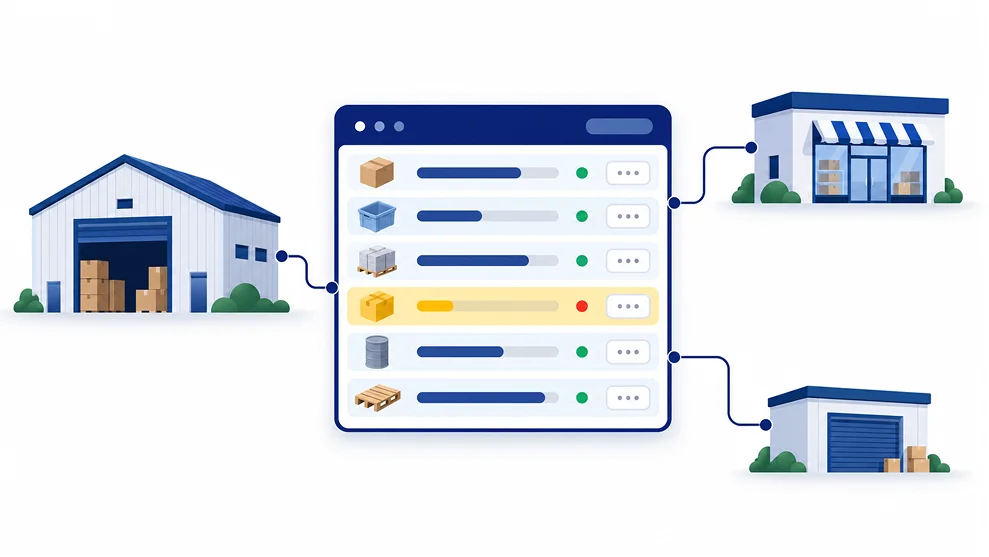
ElevatorPlus holds every store in one view: branch warehouses, site stores on long installation projects, and stock held by technicians. Transfers between them are recorded rather than informal. When somebody is about to order, they can see whether the part already exists somewhere in the business.
Because a part is dispatched on a delivery challan against a job, and the job belongs to a contract, the parts consumption of every AMC becomes visible without anyone assembling it.
That answers two questions elevator companies usually cannot. Which contracts are consuming disproportionate material, which is normally the first sign that a lift needs modernisation rather than maintenance. And which parts were used on a lift where the customer believed they were covered, but the warranty had expired.
Both of those conversations go better with a record than with a recollection.
| Scenario | Before ElevatorPlus | With ElevatorPlus |
|---|---|---|
| Stock records | ✕Registers and spreadsheets, updated when someone remembers | ✓Deducted on a delivery challan, every time, with the cost booked to a job |
| Issuing a part | ✕Verbal or a slip that may not reach the office | ✓Requested, approved and issued in the system, against a job |
| Knowing what a branch holds | ✕Ring the branch and ask | ✓Visible on one screen, across every store |
| Reordering | ✕When somebody notices a gap | ✓Alert at the reorder level you set, per item, per store |
| Van stock | ✕Effectively untracked | ✓Held against the technician, visible and reconcilable |
| Cost of a job | ✕Estimated afterwards | ✓Booked when the part is dispatched, covered or chargeable |
| Dead stock | ✕Discovered at the annual count | ✓Flagged as slow-moving |
| Multi-branch | ✕Separate inventories that duplicate each other | ✓One inventory with locations |
When does stock actually come off the count?
On the delivery challan. Nothing leaves a warehouse without one, so the moment the back office raises the challan the item deducts from that store and its cost books against the job or contract. That is true whether the customer is paying for the part or it is covered under a comprehensive AMC.
What is different for a part covered under contract?
Only one thing. A chargeable part needs a confirmed estimate from the customer before the challan is raised. A covered part does not. Everything after that is identical, including the cost being booked against the contract, which is how you find out what a comprehensive AMC really costs you to service.
Can we track stock across multiple branches?
Yes, including branch warehouses, site stores on installation projects, and stock held by individual technicians. Transfers between locations are recorded.
Can technicians request material from the app?
Yes, against the job they are working on, and the request goes to the back office for approval before it is issued.
How do reorder alerts work?
You set a reorder level per item, per store, and the alert fires when stock reaches it.
Can we see what a specific AMC contract has consumed in parts?
Yes. Parts dispatched against jobs roll up to the contract, so consumption per contract is visible.
Does it flag parts that are not moving?
Yes, slow-moving stock is visible rather than being discovered at the annual count.
Can we tell whether a part used was under warranty?
The warranty position is held on the lift record, so it is visible before an estimate goes to the customer rather than after.
What happens when a part is chargeable to the customer?
A final estimate is raised and sent for confirmation. Once the customer confirms, the delivery challan is created from the admin dashboard and the stock is dispatched against it.
Does it connect to our accounting system?
ElevatorPlus is not an accounting platform. It creates and finalises quotations and estimates, records payments against a quotation or a contract, and stores the invoices you raise elsewhere so the whole record sits in one place. Tally integration is live with customers today, and QuickBooks, Xero and others connect through our open API.
Most elevator companies discover two things when they first reconcile: they own more dead stock than they thought, and less working stock than the register says. Both are worth knowing.
Book a Demo