Elevator service software built for ASME A17.1 compliance, not adapted for it.
Contracts, callbacks, Category testing and modernisation projects in one system - flat pricing, no per-seat charges, live in weeks.

What ElevatorPlus Is?
ElevatorPlus is elevator service management software built for US lift companies running Category 1 and Category 5 testing, MCP records and multi-state licensing. It replaces spreadsheets and paper checklists with one system for contracts, callbacks, PM visits and modernisation projects - flat pricing, no per-seat charges, live in weeks. Every Category 1 and Category 5 periodic test is scheduled, recorded and stored against each unit, with QEI witness-test coordination tracked from scheduling through to results, and violations tracked from the AHJ notice through to final clearance. The Maintenance Control Program under A17.1 section 8.6 lives on the unit record, viewable on a technician's device in the machine room where an inspector expects to find it - not in a paper binder that may or may not be in the correct building when the inspector arrives. For contractors running branches across multiple states, one account covers every branch and jurisdiction. The applicable code edition is set per unit, so a New York installation and a California installation each run against the rules that apply to their specific equipment. Modernisation projects - from assessment through parts procurement, staged shutdowns, installation and final Category testing - are tracked in the same system as the maintenance contracts that follow them, so the project data and the service data stay connected rather than living in two separate tools. Technicians receive job details, unit history, access codes and prior fault records on the mobile app before arriving on site, and close out every job from the field with a branded report generated automatically.
US elevator contractors don't lose jobs on the tools. They lose them on compliance and inventory.
Multi-state compliance
Every state has its own elevator board, its own adopted edition of ASME A17.1/CSA B44, and its own inspection cadence. A contractor running branches in New York, Texas and California is simultaneously managing three regulators, three code editions and three sets of technician licensing requirements. The compliance gap only becomes visible when an AHJ inspector arrives and the MCP on file does not match the edition that jurisdiction enforces.
Parts and inventory gaps
Truck stock levels, lead times on imported components, and obsolete parts on units installed 30 or more years ago create delays that compound across a busy schedule. A technician dispatched without the right part makes two trips instead of one. Without live visibility into what each technician is carrying and what is on order across all warehouses, parts management is guesswork and the cost lands on rescheduled callbacks and extended downtime.
Technician shortage
Fewer trained technicians, more units under contract. What limits growth is utilisation rather than demand - and utilisation needs visibility. Without scheduling tools that match technician skill to job type and minimise travel between sites, a lean workforce is also an inefficient one. Planned maintenance gets displaced by urgent callbacks, MCP windows slip, and the consequence shows up at the next inspection rather than on any report a dispatcher can read today.
One system. Contracts to close-out.
Contract & AMC Management
Quote, sign and track every maintenance contract and AMC renewal from one Contract/AMC Format. Renewal dates are flagged automatically before they lapse, so no contract rolls past its end date unnoticed. Commercial terms, billing schedules and contract documents live in the same record as the service history for each unit.
PM & Job Scheduling
Every scheduled preventive-maintenance visit and installation job tracked from PM Import and Job Import. PM visits are grouped geographically to minimise travel, and the dispatch view shows every technician's workload so an urgent callback does not displace a planned visit without a deliberate decision being made. Technicians receive job details and unit history on the mobile app before arriving on site.
Warehouse & Inventory Management
Stock visibility by warehouse, category and unit of measure across every branch location. Truck stock is tracked per technician so a dispatcher can see what parts a technician is carrying before assigning a callback. Consumption is logged against each job automatically, reorder points flag before stock runs out, and purchase orders track parts from ordered through delivered.
Service & Breakdown Checklists
Every callback closed out on a structured checklist with a branded service report issued automatically on completion. The checklist captures fault description, repair performed, parts used and customer signature - all from the technician's device in the field. Nothing is rekeyed at the office. The completed report is on file the moment the technician closes the job.
Repair Order Management
Quote a repair, track it through the approval process, manage parts procurement and close it to a signed completion record - all in one flow. Repair orders linked to the unit record give the full history: what was quoted, what was approved, what parts were used and what the customer signed. For modernisation contractors, this is the commercial record that supports the final invoice and the warranty period that follows.
Role-Based User Access
Technicians, dispatch coordinators, branch managers and company owners each see only the data and functions their role requires. A technician on the mobile app sees their assigned jobs and unit history - not contract financials or other branches. A branch manager sees branch-level reporting without access to the full account. Permissions are configured once and enforced automatically across every login.
US Elevator Inspection & Compliance Requirements
Mandatory inspection regimes ElevatorPlus helps you track across key markets.
| Market | What is required | How often | Who enforces |
|---|---|---|---|
| United States | Category 1 and Category 5 tests, ASME A17.1/CSA B44 | Per the edition adopted by the jurisdiction | AHJ and the state elevator board |
| United Kingdom | Thorough examination under LOLER 1998 reg 9 | Six-monthly for lifts carrying people, twelve-monthly goods-only | HSE or the local authority |
| Germany | Hauptprüfung and Zwischenprüfung under BetrSichV | Hauptprüfung at most every two years, Zwischenprüfung at the midpoint | ZÜS |
Data compiled from official regulatory sources. Last reviewed August 2026.
From contract award to go-live in weeks, not months
Discovery & Scope
Reviewing your current site plans and compliance guidelines.
Setup & Integration
Mapping towers, shafts, milestones, and uploading historical logs.
Live Team Training
Training back-office dispatchers and field crews on the mobile app.
Continuous Handover
Going live, migrating historical service records, and setting up your maintenance schedules.
Simple pricing.
Everything included.
All modules, no per-user fees, no per-seat scaling. One flat price - contracts, PM, breakdown, inventory, installation, reporting.
See full pricing details- Contract & AMC Management
- PM & Job Scheduling
- Breakdown Checklists & Reports
- Warehouse & Inventory
- Installation Project Tracking
- Technician Mobile App
- Role-Based User Access
- MIS Reports & Dashboard
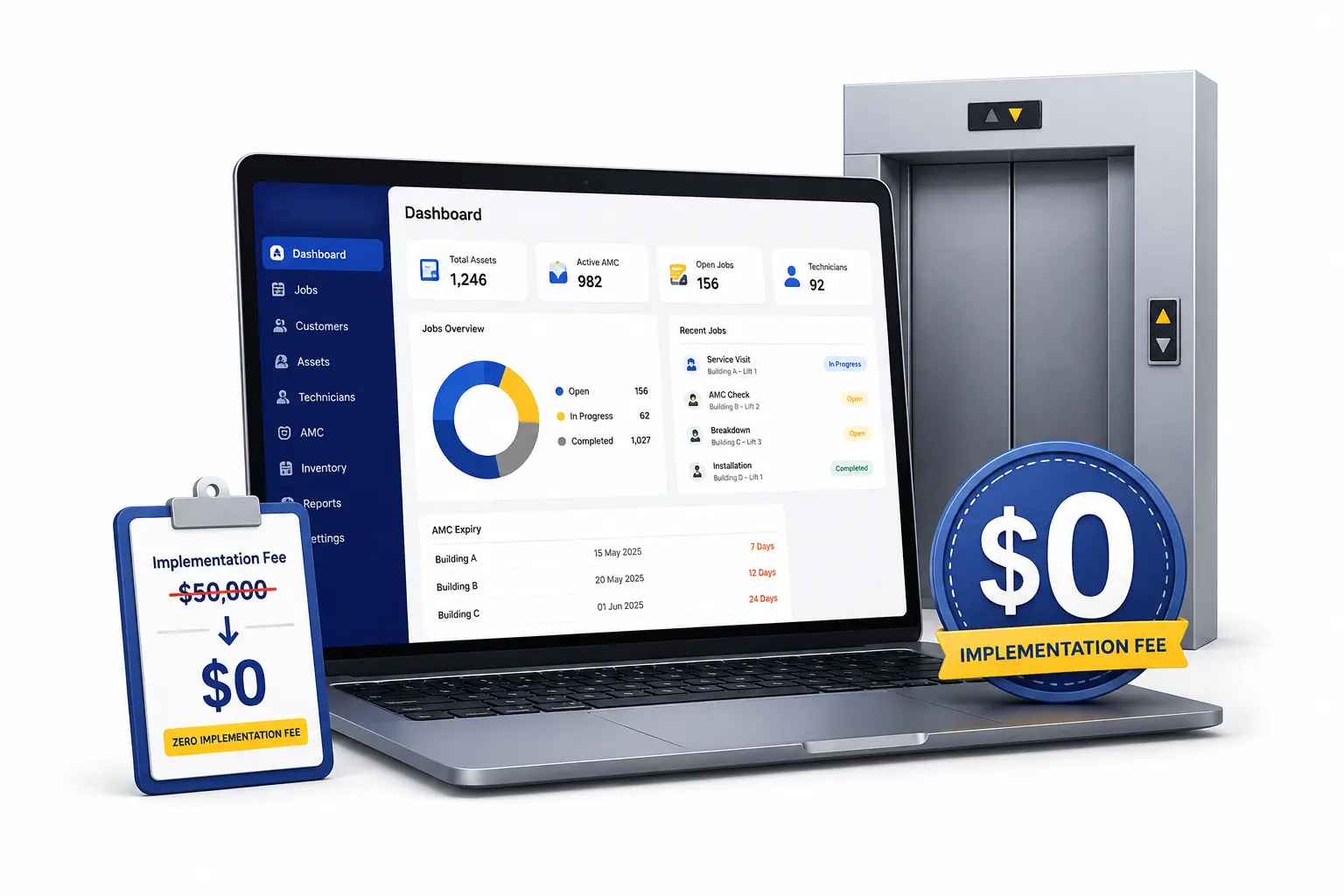
FieldBoss publishes elevator software implementation fees starting at $50,000. Our pricing is flat, with no per-user or per-seat charges.
Switching from what you run today
What the move looks like - from spreadsheets, from a generic tool, and what happens to the data you have now.
If you are running on spreadsheets and WhatsApp
Most US contractors we onboard are not replacing software. They are replacing a habit. A route schedule in Excel, a shared drive of PDF inspection reports, a technician group chat, and one person who knows where everything is. It works until you add a second state, or that person takes a week off.
The failure is rarely dramatic. A Category 1 test date slips past because it lived in one spreadsheet tab. A Maintenance Control Program record cannot be produced when the AHJ asks for it, because the last technician to touch that unit filed it in the truck. Nobody was negligent. The system was just people remembering.
If you are running a generic field service tool
The other half arrive from a general-purpose FSM platform. Those tools schedule a job and close a ticket well. What they do not have is a unit. There is no place to hold a specific elevator across twenty years of tests, parts, callbacks and inspection certificates, because they were built for HVAC and plumbing where the asset is replaceable.
So the compliance record gets bolted on as custom fields, and every new state requirement means another field. ElevatorPlus starts from the unit and works outward, which is why the ASME A17.1 record lives with the elevator instead of in a report someone builds each quarter.
What happens to the records you already have
They come with you. Contracts, unit lists, customer records, open work orders and historical service data are imported during setup, not re-keyed. If your inspection history is in spreadsheets, it imports. If it is in a previous system, it exports and imports. Nothing starts from an empty database, because a compliance record with no history is not a compliance record.
Support, once you are live
The question US contractors ask most is what happens after the invoice clears. Onboarding includes live team training rather than a video library, and support continues after go-live rather than converting to a ticket queue. Time zones are handled by the support window, not by you waiting overnight. If a technician cannot log a job on a Monday morning, that is a support call, not a support ticket. You can reach us on our international line, +1 (917) 893-3474.
The terms you will meet in US elevator compliance
If you are comparing systems, these are the words that will come up in the demo. Short definitions here, full ones in the glossary.
ASME A17.1
The North American safety code for elevators, escalators and moving walks. Which edition applies to you depends on what your jurisdiction has adopted.
Full definitionAHJ
The Authority Having Jurisdiction: the body that enforces the elevator code in a given state or province, and whose adopted code edition governs there. Two states can be on different editions at the same time.
Full definitionMaintenance Control Program
The written programme required under ASME A17.1 section 8.6, specifying examinations, tests, cleaning, lubrication and adjustments for each unit. It must be viewable on site by elevator personnel at all times, which is the part that trips up companies keeping it in an office folder.
Full definitionCategory 1 test
A periodic test at intervals set by the adopted code edition, verifying safety devices under no-load conditions.
Full definitionCategory 5 test
The more extensive periodic test, including a full-load safety test, carried out at longer intervals than a Category 1.
Full definitionQEI
A Qualified Elevator Inspector, certified to witness tests and carry out elevator inspections in the United States.
Full definitionJurisdictional Inspection
A government-mandated periodic inspection carried out by the local authority.
Full definitionMore than 140 elevator industry terms are defined in the ElevatorPlus glossary, organised by letter and by category.
Operating in more than one market?
One account runs every country you work in, each lift on its own compliance schedule.
Frequently asked questions
ElevatorPlus is built specifically for elevator maintenance contractors, not adapted from generic field service software. It manages maintenance contracts, breakdown dispatch, technician scheduling and ASME A17.1 test records on the unit record. More than 200 elevator companies run on it across 20+ countries, rated 4.9 from 128 Google reviews.
ElevatorPlus links maintenance tracking and compliance records to the same unit. Every Category 1 and Category 5 test, every violation and every mechanic credential sits on the elevator's own record instead of in a separate binder. When an AHJ inspector asks for history, you open the unit and the documentation is already there.
Yes. Category 1 and Category 5 periodic tests are scheduled, recorded and stored against each unit, with QEI witness-test coordination and violations tracked from issue through to clearance with the AHJ. Maintenance Control Program documentation lives on the unit record, where an inspector expects to find it.
Yes. One account covers every branch and state you operate in. Mechanic licences and credentials are tracked with expiry dates by state. Because the code edition in force varies by jurisdiction, records are held per unit so you defer to the local AHJ rather than to one national assumption.
Parts are tracked at warehouse and truck level, so you can see what each technician is carrying before dispatching them. Consumption is logged against the job, stock on order and in transit stays visible, and reorder points flag before a callback turns into a second visit.
Most companies are live within weeks, not months. We import your unit list, contracts and service history from your existing spreadsheets, then run in parallel for a short period so nothing is lost in the switch. Onboarding is remote, and our first international customer went live entirely online.
Yes. The technician app works fully offline. Checklists, readings, photos and signatures are captured in the pit or machine room with no signal, then sync automatically once the device reconnects. A technician never loses a completed job because a basement had no coverage.
Generic field service tools treat an elevator as a work order. ElevatorPlus treats it as a regulated asset with a code-mandated test schedule, a Maintenance Control Program, and an inspection history that has to survive an audit. Contractors switch at the point where the compliance side stops fitting inside a work-order tool - when Category test records, MCP documentation and violation tracking become a separate spreadsheet that nobody is confident is current.
Modernisation is tracked as a project with defined phases - assessment, parts procurement, staged shutdown, installation and Category 1 or 5 final testing. Each phase has assigned tasks, completion records and dates. When the project closes, the updated unit specification, test records and warranty dates carry into the new maintenance contract without re-entering data. The project data and the service data live in the same system, so the team taking over the maintenance contract has the full installation context from day one.
Yes. NEIEP journeyman cards, QEI credentials and state-specific elevator technician licences are stored against each technician with expiry dates. The system flags renewals before they lapse, so dispatching a technician on an expired licence becomes a managed risk rather than a discovered one after the fact. For a multi-state contractor where licensing requirements differ by jurisdiction, tracking credentials per technician per state is the only approach that reliably prevents a compliance incident.
Yes. The contract renewal view shows upcoming renewals across any date window, filtered by branch, account or territory. Renewals are flagged before they lapse, so the accounts team can start the conversation at the right time rather than discovering a lapsed contract when the customer calls. For a contractor managing several hundred maintenance agreements, the renewal pipeline is where the revenue forecast for the next quarter is actually built.
How do I reach ElevatorPlus from the US?
Call our international line on +1 (917) 893-3474 or email hello@elevatorplus.app. Our India office is on +91 91753 97887.
From Our Blog


Last updated: 10 August 2026
Ready to run your elevator business on autopilot?
Join elevator companies in 20+ countries already growing with ElevatorPlus.
Book a Strategy Call Now