Lift service software for Australia and New Zealand.
Plan every service visit across a state-sized territory, keep plant registration current, and produce inspection records on demand - for lift companies in Australia and New Zealand.

What ElevatorPlus Is?
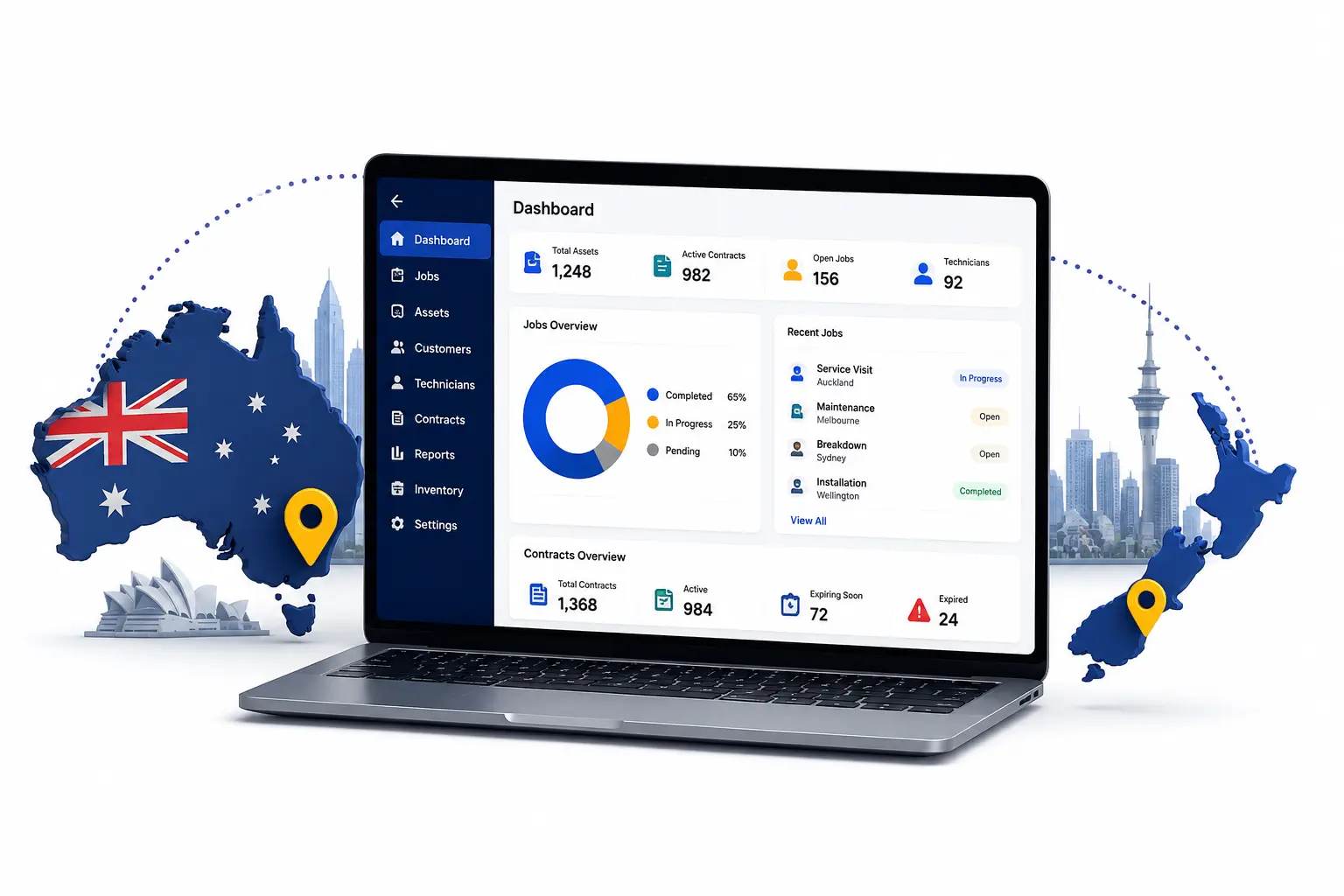
ElevatorPlus is maintenance and compliance software for Australian and New Zealand lift companies, tracking plant registration, Building Warrant of Fitness records and regional service routes - across both countries, on one account. Australia has approximately 85,000 lifts in service regulated under the Work Health and Safety Act 2011, with lifts classified as registrable plant under Schedule 5 of the WHS Regulations on a five-year renewal cycle. The registration number must be displayed on the plant, and an expired registration is grounds for a prohibition notice from the state WHS regulator. Each state runs its own regulatory body - SafeWork NSW, WorkSafe Victoria, Workplace Health and Safety Queensland - so a contractor working across multiple states tracks different regulatory contacts and, in Victoria's case, a design registration model rather than individual item registration. New Zealand's compliance is built around the Building Warrant of Fitness: the building owner must display the annual BWoF, which depends on an Independent Qualified Person certifying that specified systems including lifts have been maintained. The lift contractor produces the maintenance records the IQP relies on; if those records are missing or incomplete, the BWoF cannot be issued. ElevatorPlus holds each unit's registration number, renewal date and maintenance record in one place, viewable from any device, so both the Australian registration cycle and the New Zealand BWoF cycle are tracked per unit on their own clocks within a single account. The technician app works fully offline, which matters on regional routes where a technician may complete an entire day of visits without mobile coverage.
Australian and NZ lift companies don't fail on the work. They fail on admin and compliance gaps.
Distance is the cost centre
A regional route in Queensland, Western Australia or the South Island can be a full day's driving for three service calls. Without territory structure that groups units geographically, a technician backtracks across the same roads twice in a day and the route runs at a loss. The scheduling problem is not which technician is available - it is which technician is already in the right area, carrying the right parts, with the right access codes on their device.
Plant registration lapses
Registrable plant under WHS Regulations Schedule 5 runs on a five-year cycle with the registration number displayed on the plant. A missed renewal does not produce a warning - it produces a prohibition notice from the state WHS regulator that stops the lift immediately. For a contractor responsible for dozens of units across multiple states, tracking five-year cycles per unit in a spreadsheet is a liability that compounds as the portfolio grows.
Two regimes, one business
Operators working both sides of the Tasman manage Australian WHS plant registration and New Zealand's Building Warrant of Fitness - each with its own cadence, its own records retention requirement and its own regulatory body. A unit in Brisbane and a unit in Auckland run on completely different compliance clocks. Without a system that tracks both per unit, one of them will be managed well and the other will be managed by whoever remembered to check the calendar.
From territory setup to BWOF records - one system.
Branch & Area Territory Setup
Regional service areas modelled through Branch Master and Area Master - state-sized territories structured geographically so a technician's route is logical rather than alphabetical. Every unit in a region is grouped together, travel is minimised, and a regional technician completes a full day of visits without doubling back. As the portfolio grows, new units slot into the existing territory structure rather than landing on whoever has space.
Lift Asset Register
Every unit recorded via Product and Inventory Master - the base record that carries the WHS registration number, renewal date, maintenance history and compliance status for each installation. The asset register is the single source of truth: when a WHS regulator asks for the registration certificate or an IQP asks for the service history, the answer comes from one record rather than a search through multiple files.
Maintenance Contract & AMC Management
Every contract and AMC renewal tracked in one Contract/AMC Format, with reminders firing automatically before expiry. Contract documents, billing schedules and the maintenance history for each unit all live in the same record. Renewal conversations happen before the expiry date rather than after the customer has realised their contract lapsed without anyone noticing.
Service & Breakdown Checklists
Every job closed on a structured checklist with a branded report generated automatically on completion. The checklist captures what was done, what parts were used and the customer's signature - all from the technician's device in the field, with no paperwork to process back at the office. The record is on file the moment the job is closed, available for an IQP or WHS regulator without preparation.
Technician Mobile App
Field checklists and attendance captured on the device - no paperwork, no manual entry back at the office. The app holds a full day of work offline, which matters on regional routes where connectivity is intermittent. A technician completing six jobs in regional Queensland syncs everything when they reach coverage at the end of the run, with every job record complete and accurate.
Branch Reporting across AU & NZ
Australian and New Zealand operations reported separately within one account, with each country's compliance obligations tracked independently. An operator working both sides of the Tasman sees AU branches and NZ branches in the same dashboard without the data mixing. State-level reporting within Australia is also available by branch, so NSW and Victoria can be reported separately without running two accounts.
ANZ Lift Inspection & Compliance Requirements
Mandatory inspection regimes ElevatorPlus helps you track across key markets.
| Market | What is required | How often | Who enforces |
|---|---|---|---|
| Australia | Plant registration under WHS Regulations Schedule 5 | Five-year cycle, registration number displayed on the plant | State WHS regulator |
| New Zealand | Building Warrant of Fitness | Annual, signed by an IQP, records retained two years | MBIE, under the Building Act 2004 |
| United Kingdom | Thorough examination under LOLER 1998 reg 9 | Six-monthly for lifts carrying people | HSE or the local authority |
Data compiled from official regulatory sources. Last reviewed August 2026.
From contract award to go-live in weeks, not months
Discovery & Scope
Reviewing your current site plans and compliance guidelines.
Setup & Integration
Mapping towers, shafts, milestones, and uploading historical logs.
Live Team Training
Training back-office dispatchers and field crews on the mobile app.
Continuous Handover
Going live, migrating historical service records, and setting up your maintenance schedules.
Simple pricing.
Everything included.
All modules, no per-user fees, no per-seat scaling. One flat price - contracts, PM, breakdown, inventory, installation, reporting.
See full pricing details- Contract & AMC Management
- PM & Job Scheduling
- Breakdown Checklists & Reports
- Warehouse & Inventory
- Installation Project Tracking
- Technician Mobile App
- Role-Based User Access
- MIS Reports & Dashboard
Switching from what you run today
What the move looks like - from spreadsheets, from a generic tool, and what happens to the data you have now.
If you are running on spreadsheets and WhatsApp
Most Australian and New Zealand lift companies we onboard are replacing a habit rather than a platform. A service schedule in Excel, a folder of inspection paperwork, a technician chat, and one coordinator who knows which regional route is due. It works until the run sheet covers three states or both islands.
The failure is distance. A unit on a regional route gets visited late because the schedule was built around who was free rather than what was due. A registrable plant record cannot be produced quickly when it is asked for. Nobody was slack. The schedule was just a spreadsheet that did not know how far apart the sites were.
If you are running a generic field service tool
The rest arrive from a general FSM platform. Those tools dispatch and close jobs competently. What they do not model is a lift with a service history, an AS 1735 compliance trail and an inspection cycle that has to hold across a portfolio spread over long distances.
They also assume a technician is always connected. On regional routes that is not true. ElevatorPlus lets a technician complete a job, capture a checklist and sign it off without signal, then syncs when they are back in range, so the record is made at the unit rather than reconstructed that evening.
What happens to the records you already have
They come with you. Contracts, site and unit registers, customer records, open defects and historical service data are imported during setup rather than re-typed. Spreadsheets import. Exports from a previous system import. In New Zealand, Building Warrant of Fitness documentation stays attached to the units it covers.
Support, once you are live
The question companies here ask most is whether a supplier on the other side of the world is reachable when something breaks. Onboarding is live training with your own team rather than a video library, and support continues after go-live instead of becoming a queue. The support window covers the AEST and NZST working day. You can reach us on our international line, +1 (917) 893-3474.
The terms you will meet in Australia and New Zealand
Two countries, two regimes, one portfolio for most operators. These are the terms that matter.
AS 1735
The Australian Standard series for lifts, escalators and moving walks. Worth knowing that it sets requirements for the lifts themselves, not for software, so no software is certified against AS 1735. Any vendor claiming otherwise is worth a second question.
Full definitionRegistrable plant
Plant that must be registered with the state WHS regulator. Lifts fall into this category on a five-year registration cycle, with the registration number displayed on the plant.
Full definitionWHS Schedule 5
The schedule to the Work Health and Safety Regulations listing plant that requires registration. Note that Victoria registers plant designs rather than individual items, so a national portfolio needs both models.
Full definitionBuilding Warrant of Fitness
The annual New Zealand certificate confirming that a building's specified systems, including lifts, have been inspected and maintained. Records must be retained for two years.
Full definitionIQP
An Independently Qualified Person, who signs off the inspection records supporting a New Zealand Building Warrant of Fitness.
Full definitionThorough examination
A statutory examination by a competent person. The term travels with UK-derived practice and appears in some ANZ contract specifications.
Full definitionMore than 140 lift industry terms are defined in the ElevatorPlus glossary, organised by letter and by category.
Operating in more than one market?
One account runs every country you work in, each lift on its own compliance schedule.
Frequently asked questions
AS 1735 sets requirements for lifts themselves rather than for software, so no software is certified against it. ElevatorPlus supports your compliance with it by scheduling and recording the inspections and maintenance that AS 1735.1.1:2022 and AS 1735.12:2020 call for, and by storing the evidence against each unit.
Yes. Lifts are registrable plant under Schedule 5 of the WHS Regulations on a five-year cycle, with the registration number displayed on the plant. ElevatorPlus stores that number per unit and flags renewal ahead of expiry. Victoria registers designs rather than individual items, so Victorian units are handled separately.
Routes are built geographically, so a technician covering a regional run completes every unit in an area in one trip instead of returning twice. The app works offline, which matters on remote sites, and job data syncs the moment the technician regains coverage.
Yes. Australian and New Zealand branches run in one account with separate compliance schedules, because the two regimes differ. Australian units follow WHS plant registration, New Zealand units follow the Building Act 2004 and the annual Building Warrant of Fitness. Reporting can be viewed per country or consolidated.
Yes. The annual Building Warrant of Fitness cycle is tracked per unit, with inspection records signed off by an IQP stored against it. New Zealand requires those records retained for two years, and ElevatorPlus holds them well beyond that without you keeping a parallel paper file.
Yes. Xero integration is live. For MYOB and other accounting or ERP systems we connect through n8n, our automation layer, which covers most platforms without custom development. Tell us what you run on the call and we will confirm whether it is a standard connector or needs a short setup.
Yes. The app holds a full day of work offline. On a regional run a technician can complete every unit on the route with no signal at all, and the whole day syncs once they reach coverage. Nothing gets rekeyed back at the office.
Victoria registers designs rather than individual items, so Victorian units are handled separately from the item-registration model used in other states. ElevatorPlus stores the applicable registration type and reference per unit, so a contractor with units in Victoria and units in NSW tracks each under the correct model. The five-year renewal cycle applies where item registration applies; Victorian units are flagged with their design registration reference instead.
Yes. New Zealand requires inspection records to be retained for two years and available on demand for the IQP certifying the annual Building Warrant of Fitness. ElevatorPlus holds all service records against the unit indefinitely - well beyond the two-year minimum - so an IQP asking for the last two years of service history gets a complete record without anyone assembling it from paper files or chasing historical job sheets.
Yes. Contracts run in the currency of the client - AUD for Australian buildings, NZD for New Zealand buildings - within one account. Invoicing, billing schedules and contract values are held in the local currency. Management reporting can consolidate both into a single reference currency for head-office purposes, or view each country's figures separately depending on how the business is structured.
How do I reach ElevatorPlus from Australia or New Zealand?
Call our international line on +1 (917) 893-3474 or email hello@elevatorplus.app. Our India office is on +91 91753 97887.

Ready to run your elevator business on autopilot?
Join elevator companies in 20+ countries already growing with ElevatorPlus.
Book a Strategy Call Now