Lift companies in Kenya, Nigeria, Uganda and Ghana already run on ElevatorPlus.
Contracts, callbacks, spare parts and technician scheduling in one system. Works fully offline, syncs when coverage returns.
Trusted By


What ElevatorPlus Is?
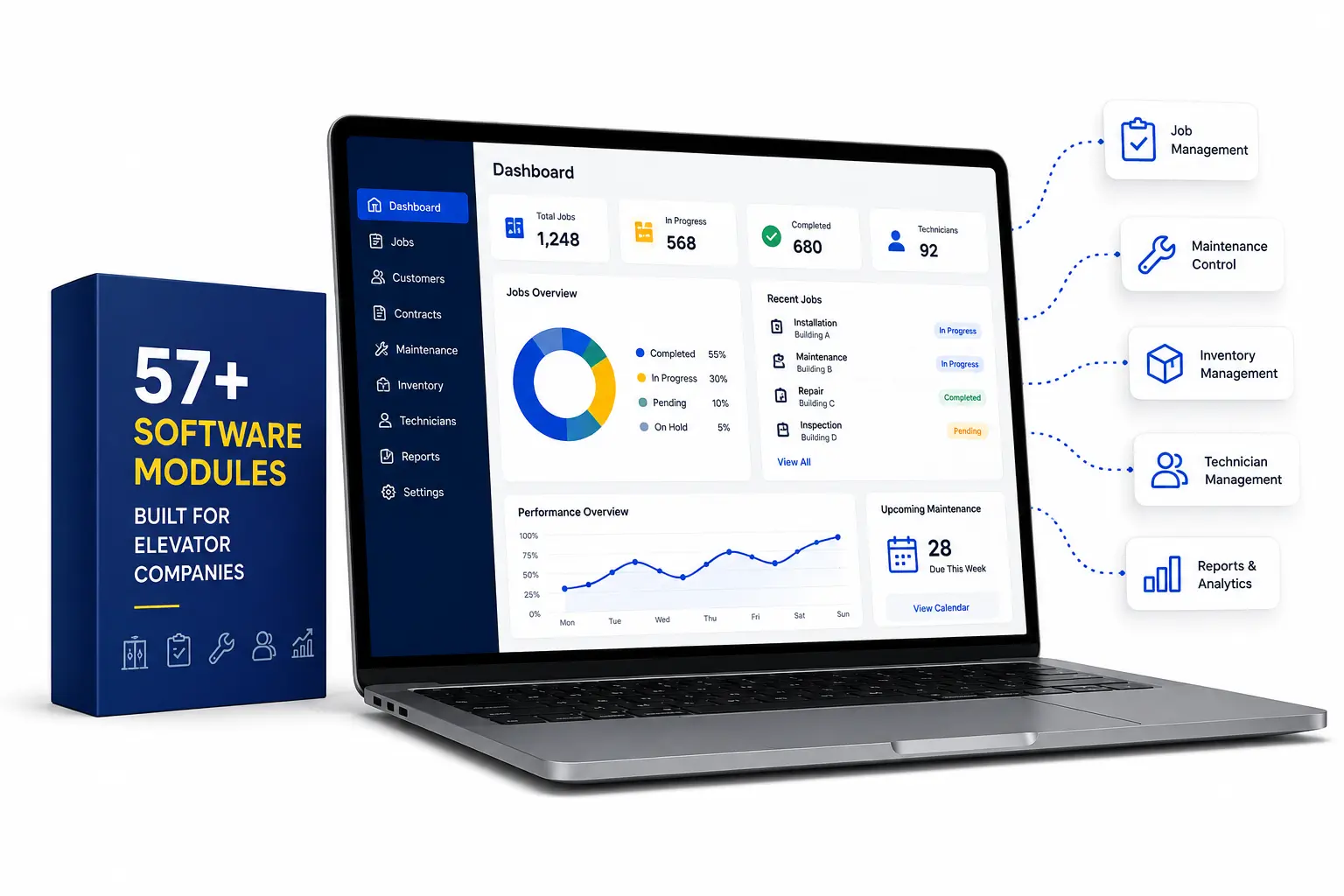
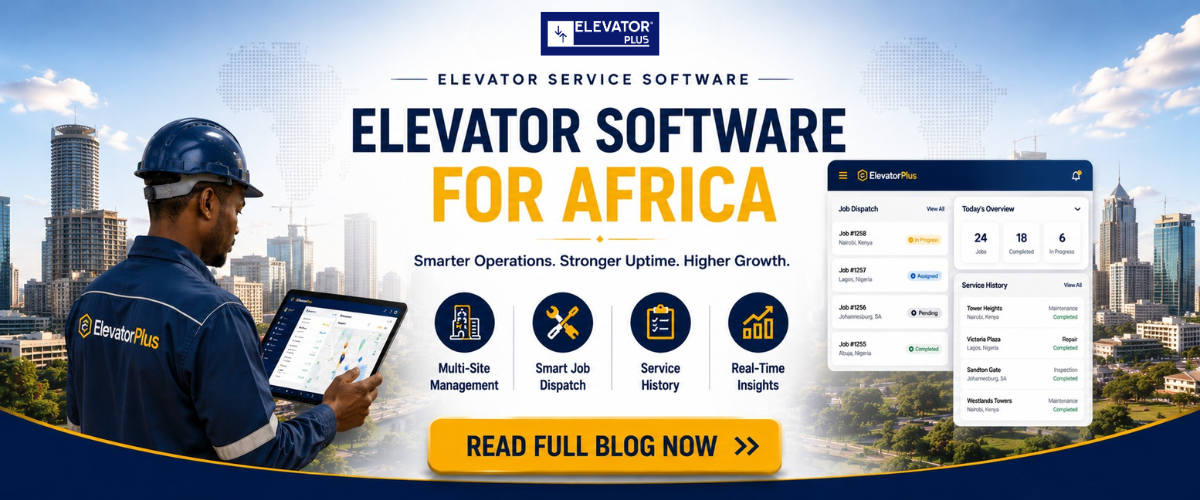
ElevatorPlus is contract and maintenance software for African lift companies, built to work fully offline and sync when coverage returns - covering contracts, callbacks, spare parts and technician scheduling. Five named clients across four countries already run on it: Wintech Instruments and RENTSTATE in Kenya, Elite Elevators and Escalators in Nigeria, Ranssie International in Uganda, and MS Consult in Ghana. Sub-Saharan Africa's installed lift base is concentrated in Nigeria, Kenya, South Africa, Ghana and Uganda, with growing activity in Tanzania and Ethiopia. Construction in Lagos, Nairobi, Accra and Kampala has been sustained - commercial real estate, government infrastructure and residential high-rises are all producing new elevator installations at a pace that outstrips the supply of capable maintenance companies. The contractors winning this work are the ones managing 25 or 50 contracts without adding a proportional number of back-office staff. Connectivity is the infrastructure constraint that defines this market operationally. A technician servicing a lift in a Nairobi basement, a Lagos machine room or a Kampala plant room may have no signal at all. Mobile data is also expensive across much of Sub-Saharan Africa, which means a platform that streams constantly is not fit for this environment. ElevatorPlus was designed offline-first: a technician holds a full day of work with no connection, captures checklists, photos, readings and customer signatures in the field, and syncs the entire day when coverage returns. Photos are compressed before upload to minimise data consumption. Nothing is rekeyed at the office and no job is lost because of a dead zone.
African lift companies run lean. The system has to work as hard as the team.
Connectivity is the constraint
Basements, plant rooms and lift shafts have no signal, and mobile data is expensive across much of Sub-Saharan Africa. A platform that requires a constant connection to function is not a platform for this market - it is a platform for a different market running on different infrastructure. The technician app in ElevatorPlus was built offline-first: every checklist, reading, photo and customer signature is captured with no connection and synced efficiently when coverage returns.
Spare parts across borders
Lead times on imported elevator components, customs clearance delays and cross-border logistics make parts management the difference between a fast fix and a week-long shutdown. A technician dispatched without the right part makes two trips instead of one. When a replacement part is on order from outside the country, the customer needs a real arrival date rather than an estimate - and that requires knowing where the part is in the supply chain, not just that it has been ordered.
Growth without admin headcount
A growing lift company in Nairobi or Lagos cannot hire a back-office team proportional to every 50 new contracts it signs. The system has to absorb the scale without the company absorbing the cost. AMC renewals that track themselves, contracts that generate their own renewal alerts, and breakdown records that close automatically from the field - these are not conveniences, they are the operational model that makes it possible to double contract volume without doubling office staff.
Built for lift businesses running lean - and running fast.
Technician Mobile App
Attendance and checklist capture in the field, offline, without any connection required. The app holds a full day of work - checklists, photos, customer signatures, parts used, fault descriptions - and syncs the entire day when coverage returns. Photos are compressed before upload to minimise data consumption. A technician who completes six jobs in an area with no signal arrives back at the office with every record already complete.
AMC & Contract Renewals
Every maintenance contract tracked with renewal dates flagged automatically before they lapse. A company managing 50 AMC contracts across Kenya and Nigeria does not need a person whose job is to check the renewal calendar - the system alerts the account manager at the right time so the renewal conversation happens before the contract expires, not after the customer stops paying.
Spare Parts & Inventory Management
Parts on hand, parts on order, parts in transit - tracked across every warehouse and branch location. Where a component is imported from outside the country, the order status, expected delivery and customs clearance stage are visible so a customer gets a real date rather than an estimate. Truck stock per technician is tracked so a dispatcher knows whether to send who is available or who is carrying the right part.
Breakdown Checklist & Reporting
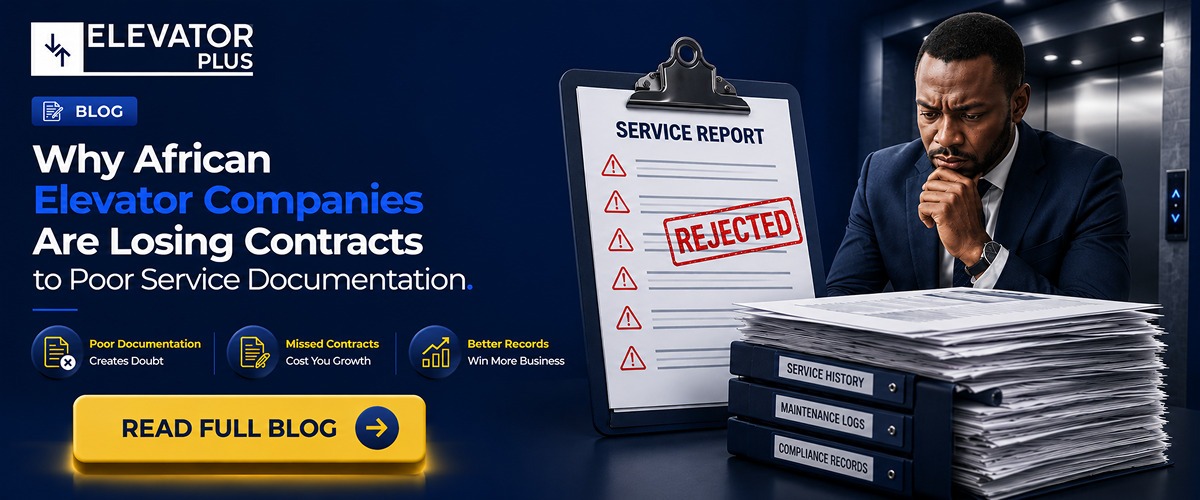
Every breakdown closed on a defined checklist with a structured service report produced automatically on completion. No unstructured job records, no paper forms to transcribe, no gap in the file where a visit should be. For a company that needs to demonstrate a track record of maintenance to win a contract renewal, a complete digital job history per unit is the evidence the client asks for.
Per-Lift Service History
Every visit tied to a unit in Product and Inventory Master, with a Report Format on file - a full asset history that travels with the lift for the life of the contract. When a client asks how many times a lift has broken down in the last 12 months, or a new contract manager wants to understand a unit's service record, the answer is in the system rather than scattered across paper files and WhatsApp messages.
Installation Project & Job Tracking
Installation projects tracked stage by stage alongside service work in one account - so a company managing both new installations and existing maintenance contracts does not run two separate systems. Project milestones, material delivery and site progress are visible at head office, and the project record carries into the maintenance contract when installation is complete.
Africa Elevator Inspection & Compliance Requirements
Mandatory inspection regimes ElevatorPlus helps you track across key markets.
| Market | What is required | How often | Who enforces |
|---|---|---|---|
| South Africa | Examination schedule under GN R.828 | Monthly; 6-monthly for ropes; 12-monthly for safety gear; 2-yearly full report | Department of Employment & Labour |
| United Kingdom | Thorough examination under LOLER 1998 reg 9 | Six-monthly for lifts carrying people | HSE or the local authority |
Data compiled from official regulatory sources. Last reviewed August 2026.
From contract award to go-live in weeks, not months
Discovery & Scope
Reviewing your current site plans and compliance guidelines.
Setup & Integration
Mapping towers, shafts, milestones, and uploading historical logs.
Live Team Training
Training back-office dispatchers and field crews on the mobile app.
Continuous Handover
Going live, migrating historical service records, and setting up your maintenance schedules.
Simple pricing.
Everything included.
All modules, no per-user fees, no per-seat scaling. One flat price - contracts, PM, breakdown, inventory, installation, reporting.
See full pricing details- Contract & AMC Management
- PM & Job Scheduling
- Breakdown Checklists & Reports
- Warehouse & Inventory
- Installation Project Tracking
- Technician Mobile App
- Role-Based User Access
- MIS Reports & Dashboard
Switching from what you run today
What the move looks like - from spreadsheets, from a generic tool, and what happens to the data you have now.
If you are running on spreadsheets and WhatsApp
Most African lift companies we onboard are replacing a routine rather than a product. A service schedule in Excel, inspection paperwork in a filing cabinet, a technician WhatsApp group, and one person who knows which client is due. It holds until the company works across two or three countries.
The failure is usually the paper trail. A load test certificate cannot be found when a client's insurer asks for it. A statutory examination falls due on a unit that changed building owner. Nobody was negligent. The record was physical and the schedule was in someone's head.
If you are running a generic field service tool
The rest come from a general FSM platform, and the gap is the unit. Those tools schedule work and close jobs. They have no place to hold one lift across years of examinations, parts, callbacks and certificates, and no concept of a competent person sign-off that has to be evidenced.
They also assume reliable connectivity and one country. A contractor working across Kenya, Uganda, Tanzania and Ghana is running several regimes and several currencies, often on sites with poor signal. ElevatorPlus lets a technician complete and sign off a job offline, then syncs when signal returns, and treats multi-country and multi-currency as defaults.
What happens to the records you already have
They come with you. Contracts, site and unit registers, customer records, open jobs and historical service data are imported during setup rather than re-typed. Spreadsheets import. Previous-system exports import. Where records are on paper, the setup team helps structure them so the digital history does not start empty.
Support, once you are live
The question companies here ask most is whether a supplier this far away is genuinely reachable. Onboarding is live training with your own technicians and office team, and support continues after go-live rather than becoming a ticket queue. The support window overlaps the EAT and WAT working day, and the technician app runs in Swahili and French alongside English. You can reach us on our international line, +1 (917) 893-3474.
The terms you will meet across African markets
Regimes differ sharply between markets here. These are the terms that come up most across the region.
OSHA 2007
Kenya's Occupational Safety and Health Act, which requires periodic statutory examination of lifts by an approved inspector.
Full definitionGN R.828
The South African Lift, Escalator and Passenger Conveyor Regulations 2010, setting a schedule of monthly examination, six-monthly rope examination, twelve-monthly safety gear testing and a two-yearly comprehensive report.
Full definitionCompetent person
The person carrying out a statutory examination, who must be sufficiently independent and impartial of the organisation maintaining the lift to make objective decisions.
Full definitionStatutory Compliance
Adherence to the local lift acts, safety codes and inspection rules that apply in each market you operate in.
Full definitionSafety Gear
The mechanical device that grips the guide rails and stops the car if it overspeeds. Its periodic testing is a scheduled item in several African regimes.
Full definitionEN 81-20 / EN 81-50
The European safety standards for lift construction and installation, widely referenced in specifications across the region.
Full definitionThorough examination
A statutory examination by a competent person, a term that travels with UK-derived practice into several African regimes.
Full definitionMore than 140 elevator industry terms are defined in the ElevatorPlus glossary, organised by letter and by category.
Operating in more than one market?
One account runs every country you work in, each lift on its own compliance schedule.
Frequently asked questions
Yes, and it was built for these markets, not retrofitted for them. Jobs, checklists, readings, photos and customer signatures are all captured with no connection at all, then sync when the device next reaches coverage. A technician working where the network is unreliable never loses a completed job.
The app is built to run light on data. It syncs job records rather than streaming, compresses photos before upload, and transfers only what has changed since the last sync. Technicians can also hold sync until they reach WiFi, which keeps a full day of work off mobile data entirely.
Yes, and customers already do. ElevatorPlus runs for Wintech Instruments and RENTSTATE in Kenya, Elite Elevators and Escalators in Nigeria, Ranssie International in Uganda, and MS Consult in Ghana. One account holds branches in several countries, each with its own currency, customers and technician teams.
KES, NGN, UGX and GHS are supported, alongside any other currency you invoice in. A Nairobi branch and a Lagos branch each bill in their own currency while head office sees one consolidated figure, which is the reporting problem multi-country operators actually run into.
Yes. Breakdown assignments, AMC expiry reminders, payment follow-ups and completed service reports all go out over WhatsApp automatically, across 30+ triggers. It runs on the official WhatsApp Business API, so an API account is required. If you do not have one, we set it up and integrate it for you. That platform carries its own cost, and the same account also runs your bulk marketing.
Onboarding is remote and most companies are live within weeks. Elevating Solutions in Nepal was our first international go-live and never had a site visit. We import your units, contracts and service history, configure your schedules and train your technicians online, so there is no travel cost and no waiting for a visit.
Yes. Parts are tracked through ordered, in transit, received and issued, so you can see what is coming and when it lands. Where lead times are long and import clearance adds delay, that visibility lets you give a customer a real date instead of an estimate.
The system absorbs the administrative load that would otherwise require more headcount. Contract renewals track themselves and send alerts at the right interval. Breakdown records close from the field without office entry. Invoices generate from completed jobs. A company that goes from 50 to 200 contracts runs more work through the same back-office team because the system handles the tracking, not a person.
Yes. A company operating in South Africa and adding Kenya or Uganda runs both markets in one account, with separate branches, currencies and technician teams. The expansion does not require a second system or a second database - the same account grows with the business, and head office sees a single reporting view across all markets.
Yes. A per-lift service history covering every visit, every checklist, every part used and every breakdown closed is available as a report at any point. When a prospective client asks what the maintenance record looks like on a lift you have been servicing, you can show them the full history from the system rather than compiling it from paper files. A visible, auditable track record is a competitive advantage when a building manager is choosing between service companies.
How do I reach ElevatorPlus from Africa?
Call our international line on +1 (917) 893-3474 or email hello@elevatorplus.app. Our India office is on +91 91753 97887.
From Our Blog




Last updated: 10 August 2026
Ready to run your elevator business on autopilot?
Join elevator companies in 20+ countries already growing with ElevatorPlus.
Book a Strategy Call Now