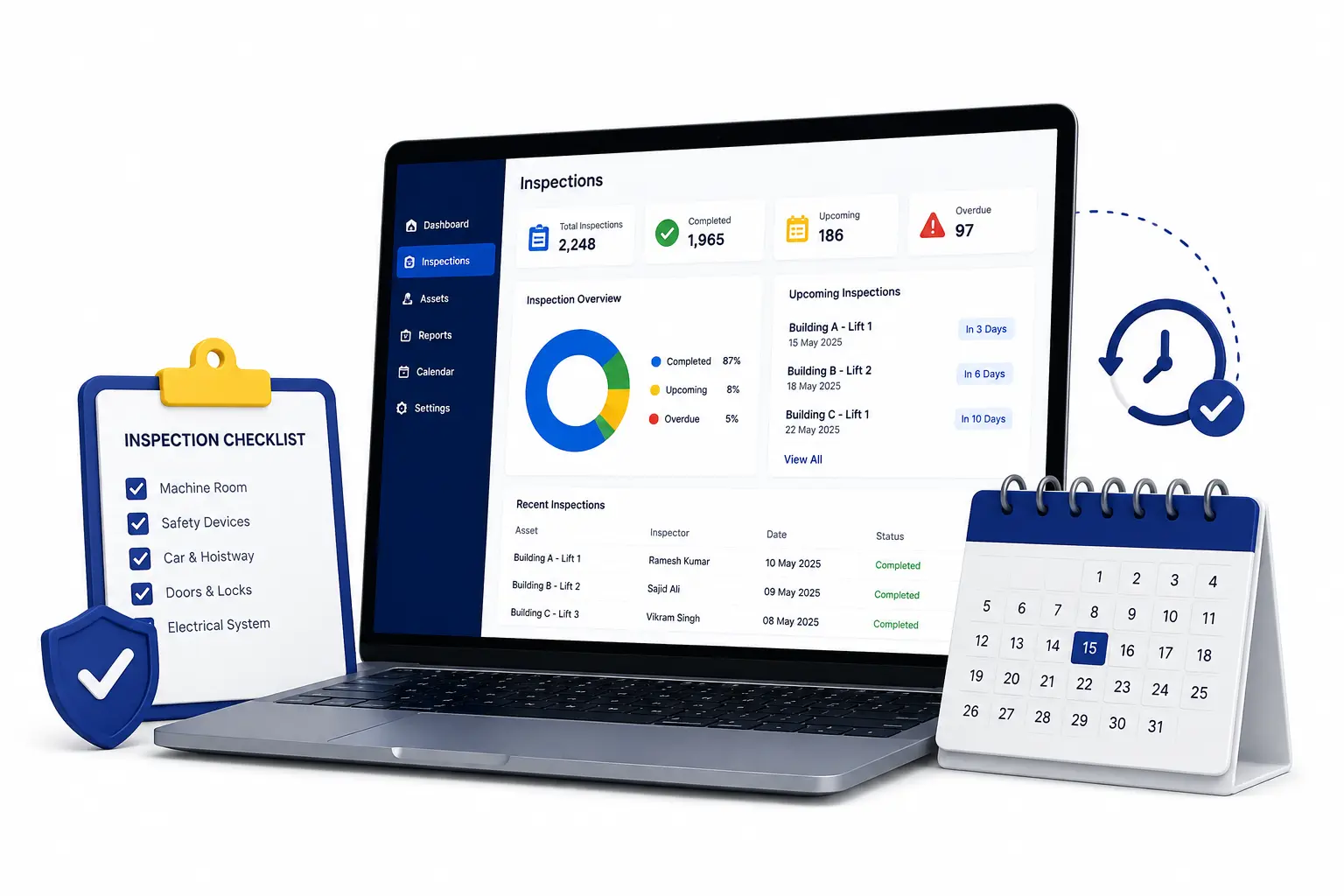
Every inspection date under control. Your records ready at any moment.
Hauptprüfung and Zwischenprüfung intervals under BetrSichV, defect rectification logged, and ZÜS-ready evidence - plus contracts and dispatch in one system.
Trusted By

What ElevatorPlus Is?
ElevatorPlus ist eine Software für Aufzugsunternehmen zur Verwaltung von Prüfterminen (Hauptprüfung und Zwischenprüfung), Prüfbuch-Dokumentation und Mängelbeseitigung in einem System - für Aufzugsunternehmen in ganz Europa. ElevatorPlus is inspection scheduling, contract management and defect close-out software for lift companies across Europe - one system covering Germany's BetrSichV regime, France's controle technique, Italy's verifica periodica and the Netherlands' 18-monthly inspection requirement. The documentation burden in European lift compliance is constant even when the rules differ by country: every inspection result has to be recorded, every defect has to be tracked to close-out, and the Prufbuch or equivalent record must be current and on site when an inspector arrives. ElevatorPlus holds the inspection schedule per unit on its own statutory clock, produces the Service Report Format consistently on every visit, and tracks every defect from identification through rectification and sign-off. For lift companies operating across multiple European countries, one account manages every market's inspection cadence, with each country's branches separated for reporting purposes. Germany, France, Belgium and the Netherlands each run under their own rules within the same platform, so a multi-country operator does not maintain a separate system for each jurisdiction. The interface is available in German, French, Italian, Dutch and more than fifteen other languages, so technicians, dispatchers and management all work in the language they use every day.
European lift compliance doesn't forgive gaps. Neither does an auditor.
Inspection regimes vary by country
BetrSichV in Germany, the arrete du 11 mars 2003 in France, DPR 162/1999 in Italy, and country-specific cadences elsewhere - the documentation burden is constant even when the rules differ. Each country's regime runs on its own clock with its own evidence requirements, and the Prufbuch or equivalent record has to be current and available on site when the inspector arrives. One missed interval in one market does not stay contained - it becomes a ZUS finding that can take the lift out of service.
Multi-country operators, one portfolio
Juggling different inspection cadences across Germany, France, Belgium and the Netherlands with no central system means a separate spreadsheet for each market, each one a single point of failure. When the German ZUS sends a notification, the French controle technique is due next month, and a Belgian defect is still open from two visits ago, there is no spreadsheet that shows all three at once without someone building it from scratch every week.
Defect close-out needs a defensible trail
Defects raised after a Hauptprüfung must be tracked to close-out with a documented rectification record - an email chain is not a defensible audit trail. Under BetrSichV, defects identified during inspection must be rectified within defined periods and the rectification must be verifiable at the next ZUS visit. A defect that was fixed but not formally closed on the record reappears at the next inspection as an unresolved finding.
Inspection to close-out. One system, every market.
Prüftermine Scheduling
Inspection cadence (Hauptprüfung and Zwischenprüfung) tracked automatically through PM Import - so every lift stays on its statutory clock without anyone manually updating a schedule. Approaching inspection dates are flagged in advance. Where France, Italy or the Netherlands applies a different interval, that is configured per unit rather than overriding a company-wide setting.
Prüfbuch-Ready Report Generation
The Service Report Format produces a consistent, presentable evidence pack on every maintenance or examination visit. Technicians close the job from the field, the report is stored against the unit, and the Prufbuch record is current before the ZUS inspector asks to see it. No visit is closed without a document on file.
Mängelbeseitigung Checklist
Defects tracked from identification through rectification and final sign-off via the Breakdown Checklist and Service Checklist. The close-out record is stored against the unit alongside the inspection report that raised the defect, so the audit trail from finding to resolution is complete and retrievable at the next ZUS visit without anyone assembling it from separate sources.
Contract & AMC Management
One Contract/AMC Format per site or portfolio, with renewal dates flagged before they lapse. Billing schedules, contract documents and service history live in the same record. The operations team and the accounts team are always looking at the same data rather than maintaining files that diverge over time.
Technician Mobile App
Field checklist and attendance captured once, on the device, in the language the technician works in. Completed jobs sync back to the office automatically. Nothing is rekeyed. In a ZUS inspection context, a technician who has closed every visit correctly from the field leaves behind a complete record rather than a stack of paper forms to be transcribed later.
Multi-Country Branch Setup
Germany, France, Belgium, the Netherlands - each modelled as its own Branch/Area in one account, with its own language, inspection regime and reporting structure. Reports roll up to a company-level view without mixing country data that needs to stay separate. A company expanding from Germany into Belgium does not need a second system - it adds a branch.
European Lift Inspection & Compliance Requirements
Mandatory inspection regimes ElevatorPlus helps you track across key markets.
| Market | What is required | How often | Who enforces |
|---|---|---|---|
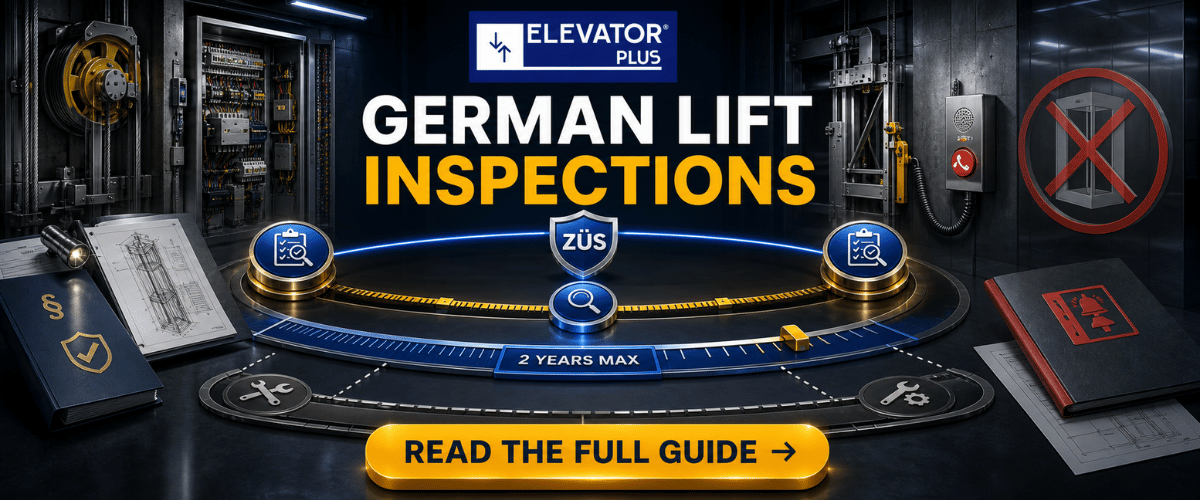
| Germany | Hauptprüfung and Zwischenprüfung under BetrSichV | Hauptprüfung at most every two years, Zwischenprüfung at the midpoint | ZÜS |
| France | Contrôle technique | Five-yearly, with a maximum six-week maintenance interval | Approved inspection body |
| Italy | Verifica periodica under DPR 162/1999 | Two-yearly | Authorised inspection body |
| Netherlands | Periodic inspection by an NL-conformiteitsbeoordelingsinstantie | Within 12 months of first use, then at most every 18 months | Certificerende instelling |
| United Kingdom | Thorough examination under LOLER 1998 reg 9 | Six-monthly for lifts carrying people | HSE or the local authority |
Data compiled from official regulatory sources. Last reviewed August 2026.
From contract award to go-live in weeks, not months
Discovery & Scope
Reviewing your current site plans and compliance guidelines.
Setup & Integration
Mapping towers, shafts, milestones, and uploading historical logs.
Live Team Training
Training back-office dispatchers and field crews on the mobile app.
Continuous Handover
Going live, migrating historical service records, and setting up your maintenance schedules.
Simple pricing.
Everything included.
All modules, no per-user fees, no per-seat scaling. One flat price - contracts, PM, breakdown, inventory, installation, reporting.
See full pricing details- Contract & AMC Management
- PM & Job Scheduling
- Breakdown Checklists & Reports
- Warehouse & Inventory
- Installation Project Tracking
- Technician Mobile App
- Role-Based User Access
- MIS Reports & Dashboard
Switching from what you run today
What the move looks like - from spreadsheets, from a generic tool, and what happens to the data you have now.
If you are running on spreadsheets and WhatsApp
Most European lift companies we onboard are replacing a routine rather than a product. Inspection dates in Excel, scanned certificates on a server, a technician chat group, and one person who knows which regime applies to which contract. That holds until the company crosses a border.
The failure is administrative, not technical. A Zwischenprüfung date is tracked in the same column as a Hauptprüfung, so the intermediate check is missed. A Prüfbuch entry cannot be produced quickly when a ZÜS inspector asks. Nobody was disorganised. One spreadsheet was being asked to model four different national regimes at once.
If you are running a generic field service tool
The rest come from a general FSM platform, and the gap is jurisdiction. Those tools schedule work and close jobs. They have no concept of a unit whose inspection interval, required documentation and responsible body all change depending on which country it stands in.
So the German portfolio gets one set of custom fields, the French portfolio another, and reconciliation happens in a spreadsheet. ElevatorPlus holds the regime on the unit, so a portfolio spanning BetrSichV in Germany, contrôle technique in France and verifica periodica in Italy runs in one system.
What happens to the records you already have
They migrate. Contracts, unit registers, customer records, open defects and historical inspection data are imported during setup rather than re-keyed. Spreadsheets import, previous-system exports import, and per-country document sets stay attached to the units they belong to. An inspection trail that starts on go-live day is not defensible, so it does not start there.
Support, once you are live
The question European companies ask most is whether support understands lifts or just software. Onboarding is live training with your own technicians and office staff. Support continues after go-live rather than converting to a ticket queue, and the interface runs in German and French alongside English so a multi-country team is not forced into one language. You can reach us on our international line, +1 (917) 893-3474.
The terms you will meet across European markets
Every European market runs its own inspection vocabulary. If you operate across borders, these are the ones your team will need.
EN 81-20 / EN 81-50
The European safety standards for the construction and installation of lifts.
Full definitionEN ISO 8100-1:2026
The successor standard to EN 81-20:2020, published by ISO in March 2026. It is not yet cited in the Official Journal, so EN 81-20:2020 and EN 81-50:2020 remain the harmonised standards conferring presumption of conformity.
Full definitionBetrSichV
Die Betriebssicherheitsverordnung, the German ordinance governing the operation and periodic inspection of lifts.
Full definitionHauptprüfung
The main German lift inspection under BetrSichV, required at intervals of at most two years.
Full definitionZwischenprüfung
The intermediate German inspection, carried out at the midpoint between two Hauptprüfungen. Tracking these in the same field as the main inspection is the most common reason one gets missed.
Full definitionZÜS
Zugelassene Überwachungsstelle, the approved monitoring body that carries out in-service lift inspections in Germany. Worth being precise here: this is not a TÜV inspection. TÜV is a trademark shared by several competing companies, and DEKRA is a ZÜS that is not a TÜV.
Full definitionPrüfbuch
The German lift inspection record book, holding a unit's inspection history and reports.
Full definitionContrôle technique
The French periodic lift inspection, required five-yearly, alongside a maintenance visit at least every six weeks.
Full definitionVerifica periodica
The Italian periodic lift inspection under DPR 162/1999, required every two years.
Full definitionMore than 140 lift industry terms are defined in the ElevatorPlus glossary, organised by letter and by category.
Operating in more than one market?
One account runs every country you work in, each lift on its own compliance schedule.
Frequently asked questions
ElevatorPlus ist in der EU gehostet und vollständig konform mit der Datenschutz-Grundverordnung (EU) 2016/679. Da die Betriebsdaten in der EU verbleiben, ist kein Drittlandtransfermechanismus erforderlich. / Hosted in the EU, fully compliant with the General Data Protection Regulation, Regulation (EU) 2016/679. EU hosting means no third-country transfer mechanism is needed for your operational data.
Ja. Die Hauptprüfung in Abständen von höchstens zwei Jahren und die Zwischenprüfung zur Halbzeit werden je Anlage terminiert und dokumentiert. Die Prüfberichte der ZÜS werden am Anlagendatensatz gespeichert, sodass der Nachweis bei der nächsten Prüfung vollständig und sofort vorliegt.
BetrSichV Anhang 1 Nr. 4.1 verlangt neben der Zwei-Wege-Kommunikation einen schriftlichen Notfallplan mit sieben Pflichtinhalten. ElevatorPlus hinterlegt diesen Notfallplan je Anlage, hält die Kontaktdaten des Notdienstes aktuell und dokumentiert Befreiungsübungen. Die Dokumentationspflicht ist damit erfüllt und im Prüffall abrufbar.
EN ISO 8100-1:2026 and EN ISO 8100-2:2026 are the successor standards to EN 81-20:2020 and EN 81-50:2020, but they are not yet cited in the Official Journal of the EU. Until they are, EN 81-20:2020 and EN 81-50:2020 remain the harmonised standards for presumption of conformity under the Lifts Directive 2014/33/EU.
Yes. One account runs branches in several countries with different inspection regimes, because the schedule is set per installation rather than per company. Germany's alternating Hauptprüfung and Zwischenprüfung, France's five-yearly contrôle technique, Italy's two-yearly verifica and the Netherlands' 18-month inspection by an NL-conformiteitsbeoordelingsinstantie each run on their own clock.
Ja, die Oberfläche ist auf Deutsch verfügbar. Ihre Techniker, Disponenten und die Verwaltung arbeiten jeweils in der Sprache, die sie täglich nutzen. ElevatorPlus unterstützt insgesamt über 15 Sprachen, sodass auch länderübergreifende Teams in einem einzigen System arbeiten können.
BetrSichV Anhang 1 Nr. 4.1 requires a written emergency plan with seven mandatory elements alongside two-way communication. ElevatorPlus stores the emergency plan per unit, keeps the emergency service contact details current, and documents evacuation exercises. The documentation requirement is met and retrievable at inspection without searching through separate files or folders.
Yes. ElevatorPlus can host data in the EU and in the UK separately, with the hosting region confirmed in writing before onboarding. For a company operating in both jurisdictions, EU data stays in the EU and UK data stays in the UK, so no third-country transfer mechanism is needed for either set of operational records. Both UK GDPR and GDPR (EU 2016/679) compliance are supported.
Yes. France's controle technique runs every five years with a maximum six-week maintenance interval, and Italy's verifica periodica runs every two years under DPR 162/1999. Both are configured per unit in ElevatorPlus as inspection events on their own statutory clocks, entirely separate from routine PM visits. Each country's intervals run independently within one account, so a company working across both markets does not manage two separate systems.
How do I reach ElevatorPlus from Europe?
Call our international line on +1 (917) 893-3474 or email hello@elevatorplus.app. Our India office is on +91 91753 97887.
From Our Blog
Last updated: 10 August 2026
Ready to run your elevator business on autopilot?
Join elevator companies in 20+ countries already growing with ElevatorPlus.
Book a Strategy Call Now