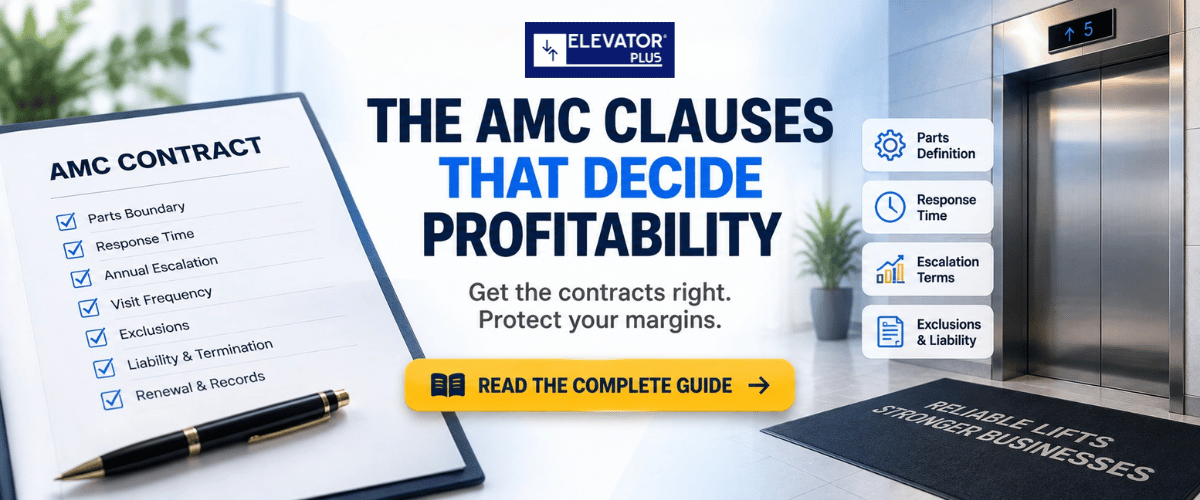
The Clauses That Decide Whether a Lift AMC Makes Money
By Nutan Mandal, ElevatorPlus · Published 7 September 2026 · Last updated 7 September 2026 · ~10 min read · Compliance reviewed by Mr. Sumeet Katariya
In short: The clause that decides whether a lift AMC makes money is the one defining what counts as a "part". Everything else is downstream. Get the parts boundary, the response definition, the escalation and the exclusions right and an average contract holds its margin. Leave them vague and no amount of good service will rescue it. Most disputes trace back to two clauses written loosely, and the loose wording is found during a breakdown rather than at signing.
Key takeaways
- "Part" is the most disputed word in lift maintenance contracts. Define it by named component list, not by adjective.
- Response means arrival to one side and resolution to the other. Write down which, and how the clock starts.
- An escalation clause with no index and no floor is a discount that grows every year.
- Exclusions only protect you if the report can prove the cause. Vandalism and water ingress are argued on evidence, not wording.
- State visit frequency per unit, not per site, and reconcile it against any statutory minimum where the lift sits. Rule 12(4)(i) of the Karnataka Lifts, Escalators and Passenger Conveyors Rules, 2015 and regulation 7 of the South African Lift, Escalator and Passenger Conveyor Regulations, 2010 each set a minimum testing or examination frequency, quoted in full below.
- Nobody negotiates who keeps the service records, and it matters more than the liability cap.
What this guide covers: the parts boundary · response definitions · annual escalation · visit frequency and the statutory floor · exclusions that hold up · obsolescence · access and site conditions · termination and notice · liability caps · renewal and lapse · service records at handover · FAQs
This is general commercial guidance and not legal advice, and contract terms should be reviewed by a qualified lawyer in the relevant jurisdiction before you sign or issue anything.
Which clauses actually decide AMC profitability?
Every AMC has dozens of lines. A handful of them carry the money.
| Clause | Written loosely it says | What it costs |
|---|---|---|
| Scope boundary | "Comprehensive maintenance" | Every rope, every controller board, argued case by case |
| Parts liability | Silent on wear versus failure | The customer expects free, you expected chargeable |
| Response time | "Prompt attendance" | No standard to defend and none to sell against |
| Escalation | No annual clause | Year three is serviced at year one prices |
| Exclusions | A short list | Vandalism, power surge and water ingress become yours |
| Obsolescence | Not present at all | You have promised to source what is no longer made |
| Renewal | Manual | Renewal is remembered or forgotten, and lapses are found late |
| Exit and data | Silent | Service history stays with whoever holds the file |
The rest of the contract protects you legally. These decide whether it earns.
Why does the parts boundary decide the contract?
Because it is where the money sits. Labour cost you can estimate. Visit frequency you set yourself. Parts are the variable that swings a profitable contract into a loss in one quarter, and the boundary between included and chargeable is almost always written in language that sounded clear in the negotiation and means nothing in the argument.
Read your own contracts. You will find some version of "minor parts and consumables included, major components chargeable". Now tell me which side a door operator belongs on. Or a landing door lock.
Everyone has a different answer and each is defensible, which is the problem. The comprehensive versus semi comprehensive distinction is the most expensive ambiguity in the Indian lift market, and it is usually settled verbally at signing, with a committee member who has since moved out of the building. The client believes they bought a comprehensive contract. You believe you sold labour with wear items thrown in. Both acted in good faith, and you will still have that conversation in month nine in front of the managing agent.
The fix is unglamorous. Define three categories rather than two adjectives, then say which the price includes.
A consumable is used up in routine maintenance: lubricants, cleaning materials, fuses, lamps. A part is a discrete item replaced within the normal wear cycle: door rollers, contacts, guide shoes, buttons, switches. A component replacement is a major assembly with its own life expectancy: machine, controller, door operator, rope set, ARD, VVVF drive.
Most workable comprehensive contracts cover consumables and parts, treat component replacements as chargeable or capped, and attach a schedule naming the assemblies. Two named lists, one included and one chargeable, appended and signed. Anything not on either list is chargeable, and you say so in the body of the agreement. That last line settles the argument when a component nobody thought about fails.
Here is the dispute it prevents. A rope set reaches its wear limit in month twenty of a three year contract. The customer reads rope replacement as included, because comprehensive means everything. You priced ropes as a life-cycle replacement, not a maintenance item. Write the rope line into the schedule and that conversation happens once, at quotation stage.
| Component | Where it usually sits | Where the dispute comes from |
|---|---|---|
| Guide shoes, brake linings, contactors | Included as wear items | Rarely disputed, which is why lists start here and stop |
| Door operator and door lock | Argued both ways | Highest failure frequency in most portfolios, so the cost is real |
| Drive, controller board, inverter | Chargeable | Client reads "comprehensive" and assumes otherwise |
| Machine, gearbox, motor rewind | Chargeable | Rarely disputed, occasionally catastrophic |
| Anything not named | Whatever your contract says | If your contract is silent, the louder party wins |
In what we see across ElevatorPlus implementations, door components generate more callouts than any other subsystem in a typical mixed portfolio. So the door operator line deserves more attention than the machine line, even though the machine costs more.
How should response time be defined?
Twice, because there are two clocks and each side only talks about one.
Your client means resolution. The lift works again. You mean attendance. A technician on site with a bag. When the contract says "four hour response" and nobody said which, you have written a guaranteed dispute.
Define both, separately, with different numbers. Attendance within a stated period for a breakdown, a shorter one for an entrapment. Resolution as soon as reasonably practicable, subject to parts availability, with a notification obligation on you if it runs long.
Then define the clock. Does it start at the client's call, at your call logging, or when your out of hours service passes it through? On a Sunday night those can be forty minutes apart. My own preference is the logged ticket, timestamped automatically rather than written by hand. And when does it stop: on site, or at the machine room? If building security cannot let your technician in for twenty minutes, whose twenty minutes was that? Write the carve-outs in too, because if the contract is silent your own service level report will show failures you did not cause. The clock pauses where access is denied, where the machine room is locked with no key holder available, or where the building's power is off.
There is a second reason to be precise, and it is not legal at all. An attendance promise across a city-wide portfolio is a resourcing decision. It sets how many technicians you need, how their routes run, and where your spares sit. Promise a window without that arithmetic and you have sold a service level you cannot staff.
It also sells. Put a committed acknowledgement and attendance window in your proposal and ask the competing quotation to match it. A vendor who will not commit to a number in writing has told the customer something useful, and you did not have to say a word against them.
What makes an escalation clause actually work?
An index, a floor, and a mechanism that needs nobody's permission.
Escalation gets left out because raising it at signing feels like it might cost the deal. So a three year contract goes out flat, and by year three you are servicing the same lifts at year one prices while wages, travel and spares have all moved. That is a real terms cut you agreed to, quietly, on the day you were most pleased about winning the work.
Where it is addressed, the common failure is wording it as "subject to mutual agreement". That is not a clause. It is an annual negotiation you have agreed to have, and you will lose it more often than you win.
A working clause names the basis: a published inflation index, a fixed percentage, or a wage-linked component if labour dominates your cost. If it is an index, name the reference month, and set a floor and a cap so neither side is exposed to something wild. It applies automatically on the anniversary with notice, and it survives renewal, so you are not resetting to year one pricing every time the contract rolls.
Put a worked illustration in the annexure so the client sees the mechanism before they sign. An increase they modelled at signing is an administrative event. The same increase arriving unannounced in year two is a price rise to be resisted. Customers who manage budgets prefer a known annual step to an unpredictable demand.
Should visit frequency be stated per unit or per site?
Per unit. Always per unit.
Write "twelve visits per year" against a site with four lifts and you have created an expensive ambiguity. The client reads it as twelve visits to each lift. Your scheduler reads it as twelve attendances at the building. State visits per unit per year, list the units by ID in the annexure, and price accordingly.
Frequency also has a legal floor in some places, and that floor overrides whatever the client agreed to. In Karnataka, rule 12(4)(i) of the Karnataka Lifts, Escalators and Passenger Conveyors Rules, 2015 requires the owner to have the lift tested by the registered person "at least once in every three months". In South Africa, regulation 7 of the Lift, Escalator and Passenger Conveyor Regulations, 2010 requires examination at least once a month, or at such longer intervals as the manufacturer prescribes, with all gates and door locks tested at each examination. Where a statutory minimum applies, a contract promising fewer visits is a problem even if the client signed it happily and wanted the cheaper option. Check the requirement where the lift sits, not where your office is.
Which exclusions hold up and which do not?
The ones your service report can support. Vandalism, water ingress, power surge and misuse are the standard four and every contract has them. Whether one works has almost nothing to do with the wording. It depends on whether your technician documented the cause at the time.
A door lock destroyed by someone forcing the doors is a vandalism claim if there is a photograph and a note. It is a goodwill repair if the report says "door fault, replaced lock". Same failure, same cost, entirely different conversation with the managing agent.
So the exclusion needs a companion obligation: you notify the client in writing, with evidence, within a stated period of attributing a failure to an excluded cause. That stops you reclassifying an expensive repair after the fact, and stops the client claiming they were never told.
Power surge is invoked most and proved least, because the evidence disappears with the event. If your portfolio sits on an unstable supply, price for it rather than relying on the clause.
What happens when a component is no longer manufactured?
This is the clause most contracts do not have, and the one that eventually costs somebody a great deal of money. Equipment outlives its supply chain. Without an obsolescence clause, your comprehensive AMC has committed you to sourcing something that does not exist, or to funding a modernisation you never priced. Their position is that you promised to keep the lift running. Yours is that you priced maintenance, not refurbishment.
So write it. Where a component is no longer available from the original manufacturer or an equivalent source, the obligation converts: you quote options, the client decides, and the repair obligation is suspended until they instruct. Add a right to reprice or terminate if they decline and the equipment becomes unmaintainable.
👉 How many of your live contracts are running past their renewal date right now? See how AMC contracts and renewal reminders are tracked →
Why should the access clause have a charge attached?
Because a technician who cannot get into the machine room has still cost you the visit. Every service manager has the story. The van arrives, the key is with a facilities manager on leave, two hours of a paid day evaporate. The contract says the client shall provide reasonable access. Reasonable to whom?
An access clause that works names a keyholder or a stated arrangement, recorded at contract start and updated when it changes. It puts a notice obligation on the client, and it carries an abortive visit charge at a stated rate. You will not invoice it every time. Having it there changes behaviour long before you raise it. The same clause should cover site conditions, because your technician's obligation to work in a machine room full of storage is not unlimited.
What about termination, notice and liability caps?
Termination is where contracts are quietly one-sided, usually because the template came from the client's side. Check whether notice is symmetrical, because a contract you can leave with three months and they can leave with one is not a five-year contract. Check whether termination for convenience exists and whether a break sum applies. Check that your right to terminate for non-payment is real, with a stated arrears period and a suspension right before it. Suspension is what actually gets invoices paid.
On liability caps, your cap should relate to the annual contract value, not to the value of the building. You are maintaining a lift, not underwriting the tenant's business. Consequential loss should be excluded, and that exclusion is worth more than the cap figure. Death and personal injury cannot be capped in most jurisdictions, so take proper advice rather than copying wording across.
How do AMC lapses actually happen?
They are almost never a decision. A renewal date sits in one person's spreadsheet, that person is on leave through the renewal month, the contract quietly stops, and nobody notices until a breakdown call arrives from a building that is no longer under contract.
Half a lapsed AMC book is common, and it is recoverable, because the customer has not chosen anyone else. They have simply not been asked. No lead cost, no site survey, and the technician already knows the machine room.
So stop relying on memory. Renewal dates held centrally, with reminders reaching a named person before the expiry rather than after, is how companies stop losing contracts by accident. The clause work makes a renewal worth having. The tracking makes sure it happens.
Who keeps the service records when the contract ends?
Almost nobody negotiates this, and it matters enormously. Every visit, every fault, every part fitted, sometimes over a decade. Whoever holds that history has a large advantage at the next tender. If your contract is silent, expect an argument at handover, at exactly the moment goodwill is lowest. The client says they paid for the service and the records document it. You say they are your working documents. Both have merit.
The sensible clause is short. The service history belongs to the customer, is provided on request during the term, and a complete set follows within a stated number of days of the contract ending, in a readable format. Writing that down costs you nothing if your records are in order, and that is the point. Clients remember an incumbent who would not hand records over.
We have been on the wrong side of this. Early on our own records sat in job books and two spreadsheets, and producing a clean history for a departing client took a week we did not have. The clause was not the problem. The record keeping was.
Frequently asked questions
Should the parts schedule sit in the contract or in an annexure?
Annexure, signed and dated, referenced from the body. Then you can revise it at renewal without redrafting.
What if a client insists on a fully comprehensive contract?
Sell it, price it properly, and still include the schedule. Comprehensive should mean everything on a named list, not everything imaginable.
How do we handle response times across a spread portfolio?
Band them. One standard for your core area, another for outliers, priced accordingly. A single blanket time is a promise you will break.
Is a fixed percentage escalation better than an index?
Simpler to administer and easier for clients to accept. An index is fairer over a long term. Either beats "subject to agreement".
Can we add an obsolescence clause to a live contract?
Only at renewal or by agreed variation. Raise it with survey evidence attached, which is far easier than raising it after a failure.
Should the contract state visits per unit or per site?
Per unit, with the unit IDs listed in the annexure. "Twelve visits per year" on a four-lift site is not a frequency, it is a future dispute. Reconcile the figure against any statutory minimum where the lift sits.
Can we cap our exposure on component replacement?
Commonly yes, by naming an annual value cap or by listing which assemblies are chargeable. Have a lawyer in your jurisdiction confirm the drafting.
What if the client refuses an escalation clause outright?
Price the flat-rate risk into year one. If they will not accept an increase later, they are asking you to carry cost inflation for the whole term, and that belongs in the number.
📲 Join our WhatsApp channel for compliance tips, updates: ElevatorPlus - Business Automation Tool
An AMC is a pricing document pretending to be a legal one. The parts boundary sets your cost exposure. The response definition sets your service exposure. Escalation decides whether year four is profitable. Exclusions decide who pays for events neither party controls, and only where your reporting supports them.
Obsolescence is the clause you will wish you had. Records is the one that costs nothing and buys you a reputation. Renewal is the one that quietly deletes contracts you already won.
Fix these clauses in your template once and every contract signed afterwards carries the correction. You are not renegotiating a portfolio, you are correcting a document and letting time do the rest.
So read your standard agreement this week. Not the one you send clients. The one you actually signed with your three largest sites.
👉 See how ElevatorPlus keeps AMC scope, parts and service history in one place. Book a demo →
Related reading
- How AMC contracts and renewal reminders are tracked
- Breakdown management, from the first call to the closed ticket
- Quotation building for maintenance and repair work
- Document automation for contracts, schedules and annexures
About the author. Nutan Mandal writes for ElevatorPlus, the Elevator Business Operating System used by 200+ elevator companies across 20+ countries.
Sources: Karnataka Lifts, Escalators and Passenger Conveyors Rules, 2015, rule 12(4)(i), testing by the registered person at least once in every three months · South Africa, Lift, Escalator and Passenger Conveyor Regulations, 2010, GN R. 828, regulation 7, monthly examination with gates and door locks tested each time. No other jurisdictions are cited, and no commercial statistics are used. The observations on door component failure frequency and on parts disputes come from ElevatorPlus client onboarding, 2026. This article is not legal advice.
👉 Follow ElevatorPlus on,
Instagram LinkedIn Facebook YouTube Qoura Substack Twitter