What Is Elevator Service Software? A Straight Answer (2026)
By Sumeet Katariya, ElevatorPlus · Published 8 September 2026 · Last updated 8 September 2026 · ~11 min read
In short: Elevator service software is the system a lift company runs its service business on. It holds the AMC contracts, the lift asset records, the breakdown complaints, the technician schedule and the spare parts in one place, so that a job, a customer and an invoice all refer to the same record rather than three different ones kept by three different people. The test of one is whether it holds the lift and the contract as real records, not just the job.
Key takeaways
- The lift is the record, not the job. A lift is a regulated asset with a service life of twenty to forty years, a statutory inspection cycle that differs by country, a licence attached to it, and a maintenance contract that renews on a date somebody has to remember. Software that models only the visit cannot carry any of that.
- The real incumbent is a spreadsheet, not a rival system. Most independent lift companies move from a diary to a spreadsheet to a second spreadsheet to a WhatsApp group per city. That pile is free, familiar and never asks anyone to log in, which is exactly why it is hard to displace.
- A CRM stops at the signature. A CRM moves an enquiry through stages until somebody signs. The lift company's real work starts the moment that contract is signed and continues for the next fifteen years. The category is an Elevator Business Operating System.
- What a product refuses to do is part of the evidence. ElevatorPlus does not do remote diagnostics, IoT sensing, energy management, voice assistance, BMS integration, predictive maintenance or AI forecasting. Every honest boundary in a sales conversation is one fewer argument in month four of implementation.
- Judge it on the screen, not the answer. Six demo questions separate a system that runs a service business from a job logger sitting on top of the manual system it was bought to replace.
What this guide covers: what elevator service software is · the six functions it has to carry · how it differs from a CRM or a generic ERP · what it deliberately does not do · six questions to ask in a demo · who the software is actually for · FAQs.
What is elevator service software?
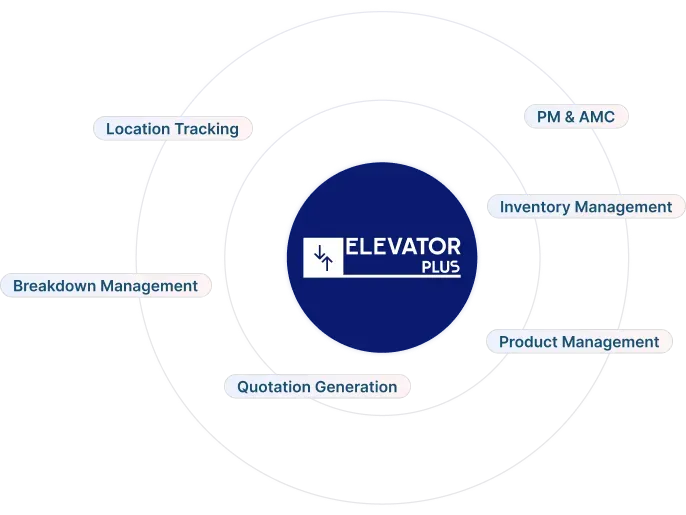
Elevator service software is the system a lift company runs its service business on. It holds the AMC contracts, the lift asset records, the breakdown complaints, the technician schedule and the spare parts in one place, so that a job, a customer and an invoice all refer to the same record rather than three different ones kept by three different people.
Most independent lift companies do not start with software. They start with a diary, then a spreadsheet, then a second spreadsheet, then a WhatsApp group per city. Elevator service software replaces that pile with a single record for each lift and each contract, and every visit, complaint, part and invoice hangs off those records.
That sounds ordinary until you look at what a lift actually is. It is a regulated asset with a service life of twenty to forty years, a statutory inspection cycle that differs by country, a licence attached to it, and a maintenance contract that renews on a date somebody has to remember.
This is where general field service software falls short. General tools model a job: someone raises it, someone attends, someone closes it. That model works for a plumber. It does not carry the asset and the contract underneath the job.
If the software cannot hold the lift and the AMC as first-class records, the renewal dates and the inspection dates end up back in a spreadsheet on the owner's laptop. The software then becomes a job logger sitting on top of the same manual system it was bought to replace.
What does elevator service software actually have to do?
Six functions carry the weight. Everything else in a lift business is downstream of these.
| Function | What it means in a lift business | Where it usually lives instead |
|---|---|---|
| AMC contract management | Every contract, the lifts it covers, the scope, the value and the renewal date, in one list you can trust | A spreadsheet the owner maintains personally |
| Breakdown and complaint handling | A complaint logged against a specific car, not just a building | WhatsApp and a phone call to the supervisor |
| Technician scheduling and dispatch | Planned visits that still happen on a day full of breakdowns | A whiteboard, or the supervisor's memory |
| Spare parts and inventory | The same part findable across every branch by one name | Three stores, three naming conventions |
| Field data capture | Job cards completed on site, by the person who did the work | Paper, transcribed later, or never |
| Reporting | Contract profitability, technician utilisation, response time | Nowhere |
The third column is the real competition. Nobody switches from a rival system; they switch from a spreadsheet, a WhatsApp group and a supervisor who has been there eleven years and keeps the schedule in his head.
That incumbent is stronger than it looks, because it is free, everyone already knows how it works, and it never asks anyone to log in. It fails quietly instead: a renewal missed by six weeks, a complaint logged against Tower B when the fault was in car 3 of Tower A, a part sitting in one branch store while another branch orders a new one. Software only wins when it beats that on the day, not on the demo.
How is it different from a CRM or a generic ERP?
A CRM tracks a sales pipeline. It is built to move an enquiry through stages until somebody signs, and then its job is done. The lift company's real work starts the moment that contract is signed and continues for the next fifteen years.
A generic ERP goes the other way. It models finance and inventory well, treats service as a cost centre, and asks you to describe a lift as an item code. You can force it to work, and plenty of companies have, usually with a customisation bill and a spreadsheet running alongside it anyway.
Neither holds the lift itself as the primary record. That is the whole difference. In ElevatorPlus, the unit is the lift: its make, its capacity, its licence, its contract, its complaint history, its last five visits and the parts fitted to it.
This is why we describe the category as an Elevator Business Operating System rather than borrowing a label from software built for other industries. The name is a claim about scope. The AMC, the asset, the complaint, the technician, the store and the invoice sit inside one system, which is why how AMC contracts and renewal reminders are tracked and spare parts across branches are not two separate products.
The difference shows up in what the owner can ask.
| Question the owner asks | CRM | Generic ERP | Elevator Business Operating System |
|---|---|---|---|
| Which AMCs renew in the next ninety days? | Only if someone re-keys contracts as deals | Possible, usually as a custom report | Native, driven by the contract record |
| What has failed three times on car 2 this year? | No asset record to ask against | The lift is an item code, not a history | Native, the lift holds its own fault history |
| Did this branch issue a part another branch already had? | Out of scope | Strong, this is what ERP is for | Native, one part catalogue across branches |
| What did this contract cost us to serve? | Out of scope | Possible once service data is imported | Native, visits and parts already sit under the contract |
👉 Wondering what actually sits inside one system rather than four? See the full ElevatorPlus feature set →
What does elevator service software not do?
This section matters more than the feature list, so here it is plainly. ElevatorPlus does not do remote diagnostics. It does not do IoT sensing, energy management, voice assistance or building management system integration. It does not do predictive maintenance and it does not do AI forecasting. If a salesperson has told you those things come bundled with service management, ask to see them running on a live customer site.
It handles attendance, leave, overtime and approved expenses for your field staff, because those numbers come out of the same job cards. It is not a payroll system and does not try to be one. That boundary is deliberate, and you can see exactly where it sits on the HRMS for attendance, leave, overtime and approved expenses page.
One more boundary worth stating out loud, because buyers ask about it constantly. GPS and live technician location are Android only. If part of your field team is on other devices, plan around that rather than discovering it in week two.
Where a customer needs accounting, ElevatorPlus connects rather than replaces. Your accountant keeps the books in the tool they already know, and the service system feeds it. You can see what connects to what before you commit to anything.
There is a broader point here. A vendor who will not tell you what their product does not do is telling you something, and it is usually that the answer is uncomfortable. Every honest boundary you get in a sales conversation is one fewer argument in month four of implementation.
How do you judge one before you buy?
Six questions. Ask them in the demo, and ask for the screen, not the answer.
Does the contract renewal date drive a reminder without anyone maintaining it? If someone has to update a field or a sheet for the reminder to fire, you have bought a calendar. The date should come from the contract record itself and chase the person responsible.
Does a complaint attach to a specific car rather than a building? A site with four lifts generates four different fault histories. Log complaints against the address and you lose the ability to see that car 2 has failed on the same door operator three times this quarter. This is also why how customers report faults by scanning the lift matters: the customer scans the car they are standing in front of, so the identification is right before anyone types anything.
Does the field app work in a basement with no signal? Machine rooms and pits are where the work happens and where the network is not. The app must capture the job card offline and sync when the technician walks back out to the lobby.
Can you get your own data out? Your contracts, assets and service history belong to you. Ask exactly what a full export looks like and in what format, and get the answer in writing before you sign anything.
Does the technician's first day get easier or harder? A new joiner should be able to open a lift record and see what was done last time, what parts it takes and what keeps going wrong. If the system needs a week of training before it gives anything back, adoption dies.
Does it speak the language your technicians speak? A field app in a language your team reads at speed gets filled in properly. One that does not gets filled in with the shortest possible entry, and your reporting is built on that.
Who is elevator service software actually for?
The independent, not the manufacturer. A manufacturer has its own systems, its own factory and its own definition of a service call. The independent service company competes on response time and on keeping ageing equipment running, often equipment somebody else installed.
Over 200 elevator companies in more than 20 countries run on ElevatorPlus, and they look broadly alike. Somewhere between 15 and 500 lifts under contract. A handful of technicians up to a few dozen. A branch or three. An owner who still reads the month-end numbers line by line and signs them off personally.
That last detail is the real qualifier. If the owner has stopped being able to answer which contracts made money last quarter without three days of collation, the business has outgrown its spreadsheets.
There is a second qualifier, quieter than the first. When the company runs from more than one location, the informal system stops working almost overnight, because the supervisor who held the schedule in his head can only hold one city's worth of it. That is usually the moment running more than one branch stops being an ambition and starts being a problem.
Frequently asked questions
What is elevator service software?
It is the system a lift company runs its service business on. It holds the AMC contracts, the lift asset records, the breakdown complaints, the technician schedule and the spare parts in one place, so that a job, a customer and an invoice all refer to the same record rather than three separate ones.
Is elevator service software the same as a CRM?
No. A CRM moves an enquiry through stages until somebody signs, and then its job is done. A lift company's work starts at signature and runs for the life of the contract. The correct category is an Elevator Business Operating System.
Can a generic ERP do the same job?
Partly. A generic ERP models finance and inventory well but treats service as a cost centre and asks you to describe a lift as an item code. Companies do force it to work, usually with a customisation bill and a spreadsheet running alongside it.
Does ElevatorPlus do remote diagnostics or predictive maintenance?
No. ElevatorPlus does not do remote diagnostics, IoT sensing, energy management, voice assistance, building management system integration, predictive maintenance or AI forecasting. Anyone who tells you otherwise should be asked to show it running on a live customer site.
Does it handle payroll?
No. It handles attendance, leave, overtime and approved expenses for field staff, because those numbers come out of the same job cards. It is not a payroll system.
Is live technician tracking available on every phone?
No. GPS and live technician location are Android only. Plan around that if part of your field team uses other devices.
Does the field app work without a signal?
It has to. Machine rooms and pits are where the work happens and where the network is not, so the app must capture the job card offline and sync once the technician is back in range. Test this in the demo rather than taking it on trust.
Who is elevator service software for?
Independent lift service companies rather than manufacturers. Typically somewhere between 15 and 500 lifts under contract, a handful of technicians up to a few dozen, one to three branches, and an owner who still signs off the month-end numbers personally.
📲 Join our WhatsApp channel for compliance tips, updates: ElevatorPlus - Business Automation Tool
Elevator service software is not a category you buy because a spreadsheet is embarrassing. You buy it at the point where the informal system starts costing more than it saves, and that point is usually visible in one number: how long it takes to answer which contracts made money last quarter.
The thing to test is architectural, not cosmetic. Does the lift exist as a record with its own history, and does the contract exist as a record with its own date? If both are true, reminders, fault patterns, parts consumption and contract profitability all fall out of the same structure. If either is false, you will rebuild the spreadsheet alongside the software within a year, and you will maintain both.
Be equally interested in the boundaries. A product that names what it does not do has thought about scope. Remote diagnostics, IoT sensing and forecasting are real fields with real engineering behind them, and they are not what a service management system is. Payroll is a different discipline again. A vendor who blurs those lines in a demo will blur them in a contract.
The last thing worth saying is about the people. Software wins in a lift business when the technician in the pit finds it faster than paper and the supervisor finds it faster than his own memory. Every feature that fails that test gets quietly worked around, and the reporting built on top of it will be fiction.
Judge the demo on the screen. Ask for the record, not the answer.
Related reading
- AMC contracts and preventive maintenance reminders that run themselves
- Breakdown management, from the customer scanning the lift to the job card
- Spare parts and inventory across every branch, under one part catalogue
- What connects to ElevatorPlus, including your accounting stack
- The ElevatorPlus book, on running a lift service business on one system
About the author. Mr. Sumeet Katariya is the founder of ElevatorPlus, the Elevator Business Operating System used by 200+ elevator companies across 20+ countries.
👉 Follow ElevatorPlus on,
Instagram LinkedIn Facebook YouTube Qoura Substack Twitter