Lift AMC Profitability: Which AMCs Lose Money?
Which of Your Lift AMCs Lose Money? Per-Lift Profitability in Four Numbers
By Mr. Sujit Katariya, ElevatorPlus ·
In short: Lift AMC profitability comes down to four numbers per lift for the last 12 months: the AMC value for that lift, the technician hours spent on it, the travel to reach it, and the parts fitted but not billed. Convert hours and travel into cost with your own rates, subtract from the value, and rank every lift. Most AMC books have a handful of lifts that cost more to service than they earn. Find them before renewal, then reprice, change the scope, quote the repair or let the contract go.
Key takeaways
- Profit is per lift, not per customer. A society paying well for three lifts can still be losing money on one of them.
- Four numbers are enough. AMC value, labour hours, travel and unbilled parts. Everything else is detail.
- Breakdowns are where the money goes. A preventive visit is planned and priced. A breakdown call is neither, and an old lift can produce many.
- Use your own cost per hour. Total technician cost divided by hours actually available for work. No benchmark is as accurate as your own payroll.
- Run it before renewals, not after. The time to find a loss-making AMC is 60 days before it expires, while the renewal letter can still change.
What this guide covers: Why profitability is per lift · The four numbers · Your cost per hour · A worked illustrative example · What to do with a loss-making lift · Running it every quarter · FAQs
Why measure AMC profitability per lift?
Because the contract hides the lift. An AMC for a housing society with four lifts arrives as one value and one invoice. Inside it, a new lift in Wing A may need nothing but planned visits. An older lift in Wing C may need a technician every other week.
Averaged over the contract, both look fine. Separated, one is carrying the other.
This is a different question from pricing. Lift AMC Charges in India 2026: Pricing Benchmark builds a floor price per lift before you quote. This guide checks the contracts you already hold, using what actually happened in the last 12 months. For what your systems need to do across AMC, breakdowns and stores, see Elevator Maintenance Software: What It Has to Do (2026).
What are the four numbers?
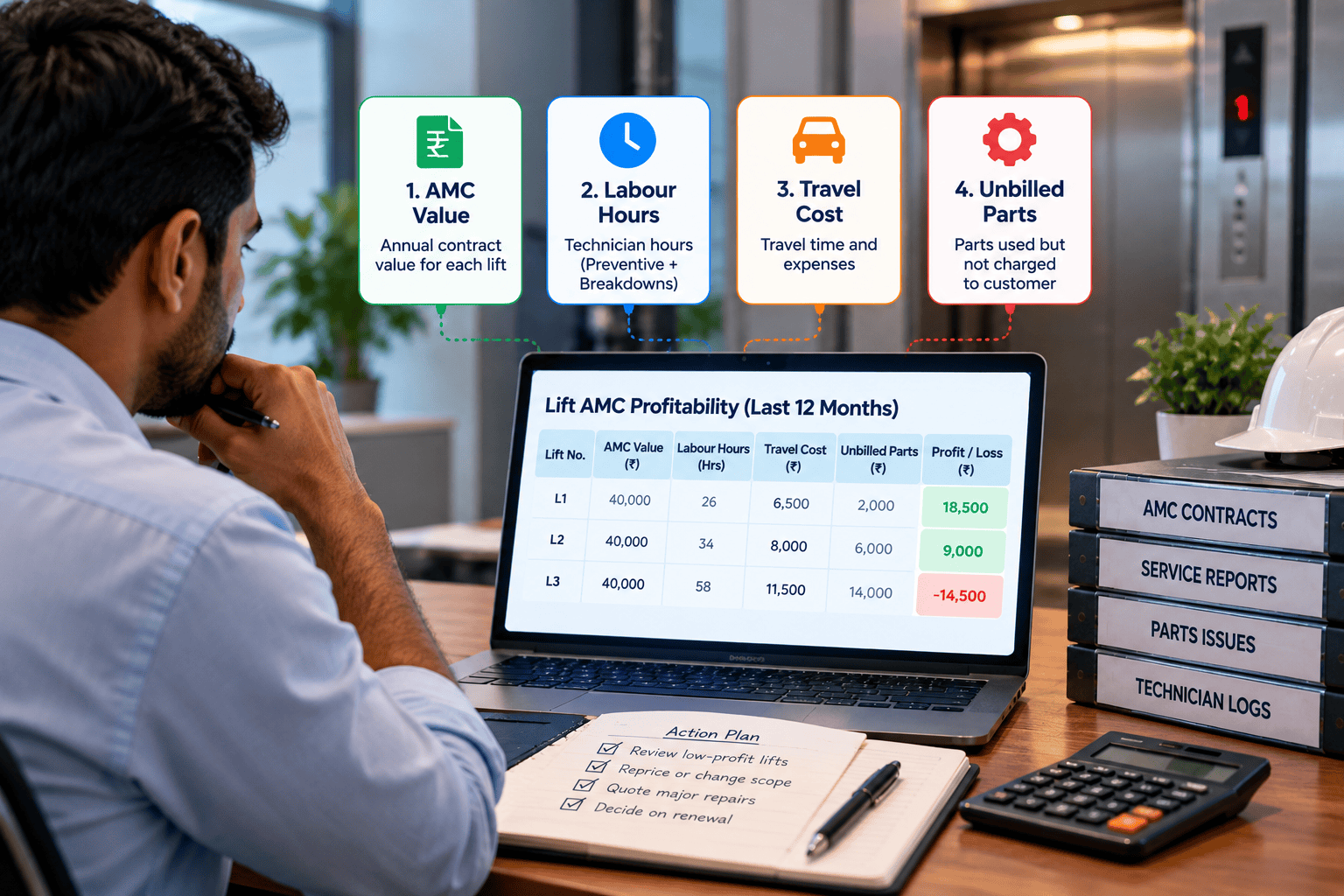
For each lift, over the last 12 months:
| # | Number | Where it comes from | How to count it |
|---|---|---|---|
| 1 | AMC value | Your contract | The annual value for that lift. If one value covers several lifts, split it by lift, or as your contract splits it |
| 2 | Labour hours | Visit records and breakdown records | Hours on site for every preventive visit plus every breakdown attended |
| 3 | Travel | Technician travel records or claims | Hours travelling to and from that lift, plus any travel expenses paid |
| 4 | Unbilled parts | Stores issue records | Parts issued for that lift and not charged to the customer, at your purchase cost |
Then:
Lift profit = AMC value − (labour hours × cost per hour) − (travel hours × cost per hour) − travel expenses − unbilled parts
On a comprehensive AMC, most parts fitted will sit in number 4, because they are covered. On a non-comprehensive AMC, number 4 should be small. If it is not, parts are being fitted and not billed, which is a separate leak worth chasing.
Why count breakdowns inside labour hours?
Because they are the part of the cost you did not plan. A preventive visit happens on a schedule you priced. A breakdown happens when the lift decides. Count the breakdowns separately as well, as a fifth column for reference. A lift with a high breakdown count is usually the lift with the loss.
How do you work out your cost per hour?
From your own numbers, once a year.
| Step | What to take | Example of where it sits |
|---|---|---|
| 1 | Total annual cost of field technicians: salary, overtime, allowances, statutory contributions | Your payroll |
| 2 | Add tools, uniforms, phones and vehicle costs for the field team | Your expense ledger |
| 3 | Count hours actually available for work in a year, per technician, after leave and holidays | Attendance records |
| 4 | Multiply by the number of technicians | |
| 5 | Divide step 1 plus step 2 by step 4 | Your cost per hour |
Use the same rate for travel hours. A technician driving to a site is paid the same as a technician working on it. That hour is a cost whether or not the lift was touched.
Do not use a benchmark from another company. Your wage levels, your city and your route density are your own. The number from your own payroll is the one that matches your contracts.
A worked example, with illustrative numbers
The figures below are illustrative round numbers, not data from any company. Assume a cost per hour of 500, in whatever currency you use, and one AMC covering three lifts at one site. The AMC value is split equally across the three.
| Illustrative | Lift 1 (newer) | Lift 2 (mid life) | Lift 3 (older) |
|---|---|---|---|
| 1. AMC value | 40,000 | 40,000 | 40,000 |
| Preventive visits | 12 | 12 | 12 |
| Breakdowns attended | 1 | 4 | 11 |
| 2. Labour hours (visits plus breakdowns) | 26 | 34 | 58 |
| Labour cost at 500 per hour | 13,000 | 17,000 | 29,000 |
| 3. Travel hours | 13 | 16 | 23 |
| Travel cost at 500 per hour | 6,500 | 8,000 | 11,500 |
| 4. Unbilled parts | 2,000 | 6,000 | 14,000 |
| Lift profit | 18,500 | 9,000 | −14,500 |
The contract as a whole earns 13,000 on these numbers. Lift 3 loses 14,500 of it. At renewal, the same total value for three lifts would carry that loss forward for another year.
The pattern is common in shape, even though every company's numbers differ. The newer lift pays for the older one, and nobody sees it until the lifts are split.
What do you do with a lift that loses money?
Four options. Pick one per lift, and write down why.
| Option | When it fits | What to do |
|---|---|---|
| Reprice at renewal | The lift is serviceable, the loss is from rate | Set the renewal value per lift, explain the change in one line in the renewal letter |
| Change the scope | Parts drive the loss on a comprehensive AMC | Propose non-comprehensive, or cap specific parts, at renewal |
| Quote the repair | Breakdowns trace to one worn component | Quote the repair or modernisation separately. A fixed lift stops generating calls |
| Let it go | The customer will not move on rate or scope | Do not renew. Write down the reason so the decision is visible |
Repricing needs evidence. The breakdown count and the parts list from the last 12 months are the strongest case you can put in front of a society committee. How to set out the number and the reason in the letter itself is covered in Lift AMC Renewal Letter: A Format That Gets Signed Before Expiry.
Changing scope means reading what your current contract says about parts. The parts boundary is the clause that decides most of this, and it is set out in The Clauses That Decide Whether a Lift AMC Makes Money.
👉 Can you pull 12 months of visits, breakdowns and parts for one lift without calling a technician? See how AMC visits, breakdowns and renewals are tracked in ElevatorPlus →
How do you run this across the whole AMC book?
Start with the contracts that renew in the next 90 days. That is the list where a finding can still change a number.
| Week | Task | Output |
|---|---|---|
| Week 1 | Work out your cost per hour from payroll and attendance | One rate for the year |
| Week 1 | List every AMC renewing in the next 90 days, split into lifts | One row per lift |
| Week 2 | For each lift, count preventive visits, breakdowns and hours on site | Numbers 2 and the breakdown count |
| Week 2 | Add travel hours and travel expenses for each lift | Number 3 |
| Week 3 | Match parts issued to each lift against what was billed | Number 4 |
| Week 3 | Calculate lift profit and rank all lifts, lowest first | The loss list |
| Week 4 | Decide one option per loss-making lift: reprice, rescope, repair or let go | A decision and a reason per lift |
Then repeat each quarter for the next 90 days of renewals. After a year, every lift in the book has been checked once, just before it mattered.
What if you cannot get the numbers?
Then that is the first finding. If hours on site are not recorded per lift, if breakdowns sit in a WhatsApp group, or if parts leave stores without a lift number, you cannot run this method. Fix the record before you fix the price.
The order of fixes that pays fastest: record every breakdown against a lift number, then issue every part against a job or lift, then record travel. Breakdowns first, because they carry most of the loss.
How ElevatorPlus handles this
In ElevatorPlus, preventive visits and breakdowns are logged against each lift, so the visit count and breakdown count in this method come from the lift record. A report shows the visits, breakdown calls and parts used for each lift against its AMC value, so the loss list starts from one report instead of three registers. You apply your own cost per hour to it. Inventory management issues parts to a technician against a specific job or lift, which is number 4. For travel, ElevatorPlus records live technician location and distance travelled on Android, configurable to your own SOP.
AMC management sends renewal reminders 60 days, 30 days and 1 day before expiry. That gives you the window to run the four numbers on a contract before its renewal letter goes out.
Frequently asked questions
1. How do I know if a lift AMC is profitable?
Take the AMC value for that lift over 12 months. Subtract labour hours and travel hours at your own cost per hour, travel expenses, and parts fitted but not billed. What remains is the lift's profit.
2. Why measure profitability per lift and not per contract?
Because one contract can cover several lifts of different ages. A newer lift can hide the loss on an older one when you only look at the contract total.
3. How do I calculate my technician cost per hour?
Add the annual cost of your field technicians, including allowances and vehicle and phone costs, then divide by the hours they are actually available for work after leave and holidays.
4. Should travel time be counted as a cost?
Yes. A technician travelling to a site is paid for that time. Count travel hours at the same cost per hour as time on site, and add any travel expenses paid.
5. What causes a lift AMC to lose money?
Usually frequent breakdowns on an older lift, parts fitted under a comprehensive AMC, or long travel to a single site. The breakdown count is the first number to check.
6. Is this the same as pricing a new AMC?
No. Pricing builds a floor before you quote. This method checks contracts you already hold, using what actually happened in the last 12 months.
7. What should I do with a loss-making AMC?
Reprice it at renewal, change the scope, quote the repair that would stop the breakdowns, or let it go. Write down which, and why, for each lift.
📲 Join our WhatsApp channel for compliance tips, updates: ElevatorPlus - Business Automation Tool
Most AMC books carry a few lifts that cost more than they earn. They are rarely the customers who complain about price. They are the quiet older lifts that call a technician every few weeks.
Four numbers per lift will find them. You do not need a consultant or a benchmark. You need visit records, breakdown records, travel and a stores issue list, each tied to a lift number.
Run it on the next 90 days of renewals first. A loss you find before the renewal letter goes out is a decision. A loss you find after is another year of the same.
👉 Find out which of your AMCs are costing you money. Book the Revenue Leak Walk-Through →
Related reading
- Lift AMC Charges in India 2026: Pricing Benchmark
- The Clauses That Decide Whether a Lift AMC Makes Money
- The AMC Contract Audit: What Are You Servicing?
- AMC Renewal Recovery: Winning Back Lapsed Contracts
- Lift AMC Renewal Letter: A Format That Gets Signed Before Expiry
About the author. Mr Sujit Katariya is part of the team at ElevatorPlus, the Elevator Business Operating System used by 200+ elevator companies across 20+ countries.
Sources: Drawn from ElevatorPlus onboarding work with 200+ elevator companies across 20+ countries.
👉 Follow ElevatorPlus on,
Instagram LinkedIn Facebook YouTube Qoura Substack Twitter