Lift Company Audit: AMC Book, Records, Stores and Cash
The Year-End Audit for Lift Companies: AMC Book, Records, Stores and Cash
By Mr. Sumeet Katariya, ElevatorPlus ·
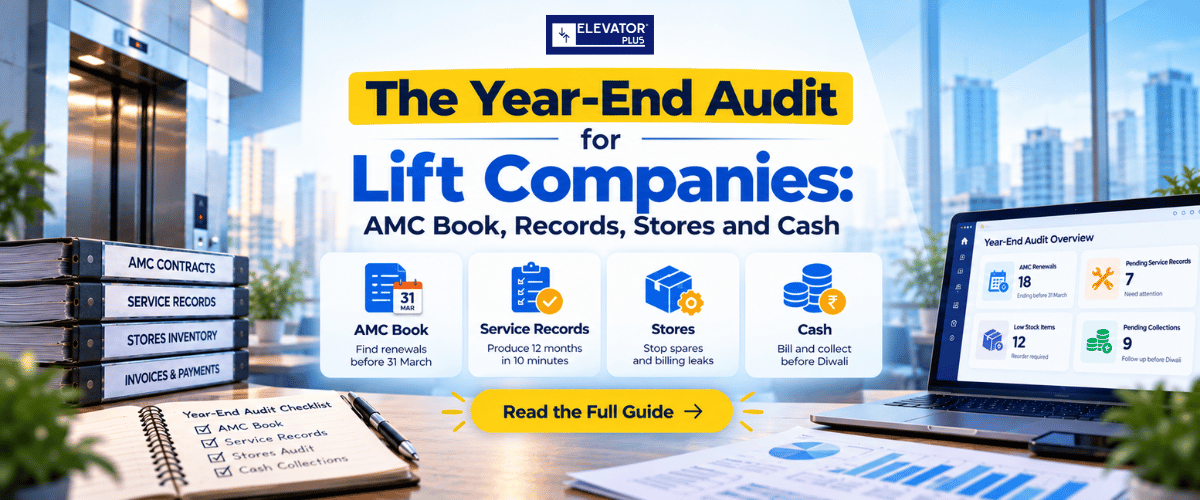
In short: A lift company audit before the financial year closes should cover four things: the AMC book, the service records, the stores and the cash. Each takes about a week. Find every AMC expiring before 31 March and every contract that has already lapsed. Test whether you can produce 12 months of visits on one lift in 10 minutes. Find spares bought twice across branches and parts fitted but never billed. Then bill the work already done and collect before Diwali on 8 November 2026.
Key takeaways
- Your AMC book is a list of dates before it is a list of customers. Every contract ending before 31 March needs a renewal conversation started now.
- The records test takes 10 minutes or it fails. Pick one lift and ask for every visit in the last 12 months. Time it.
- Stores lose money in two quiet ways. The same spare bought twice by two branches, and a part fitted on site that never reached an invoice.
- Cash leaks between job done and invoice raised. Bill completed work first, then chase what is unpaid.
- Diwali is the natural collection deadline. Diwali falls on 8 November 2026. A call made in late October lands before the festival, not after it.
What this guide covers: Why run a year-end audit now · Week 1: the AMC book · Week 2: the records · Week 3: the stores · Week 4: the cash · FAQs
Why should a lift company run a year-end audit in October?
Because most of what goes wrong in March starts in October. An AMC that expires in February needs its renewal conversation in December. A part fitted in September and not billed is already hard to recover. A collection you do not make before Diwali often waits until after the festive season.
This page is the working companion to "The Year-End Audit", a four-part series in our LinkedIn newsletter, The Elevator Business Brief, published through October 2026. The newsletter makes the case. This page gives you the checklists.
Each section below is one week. Each week runs Monday to Saturday. One person owns each week, and the owner signs off on Saturday. If you run more than one branch, run each week per branch, then compare.
For the wider view of what your systems need to do across service, AMC and stores, see Elevator Maintenance Software: What It Has to Do (2026).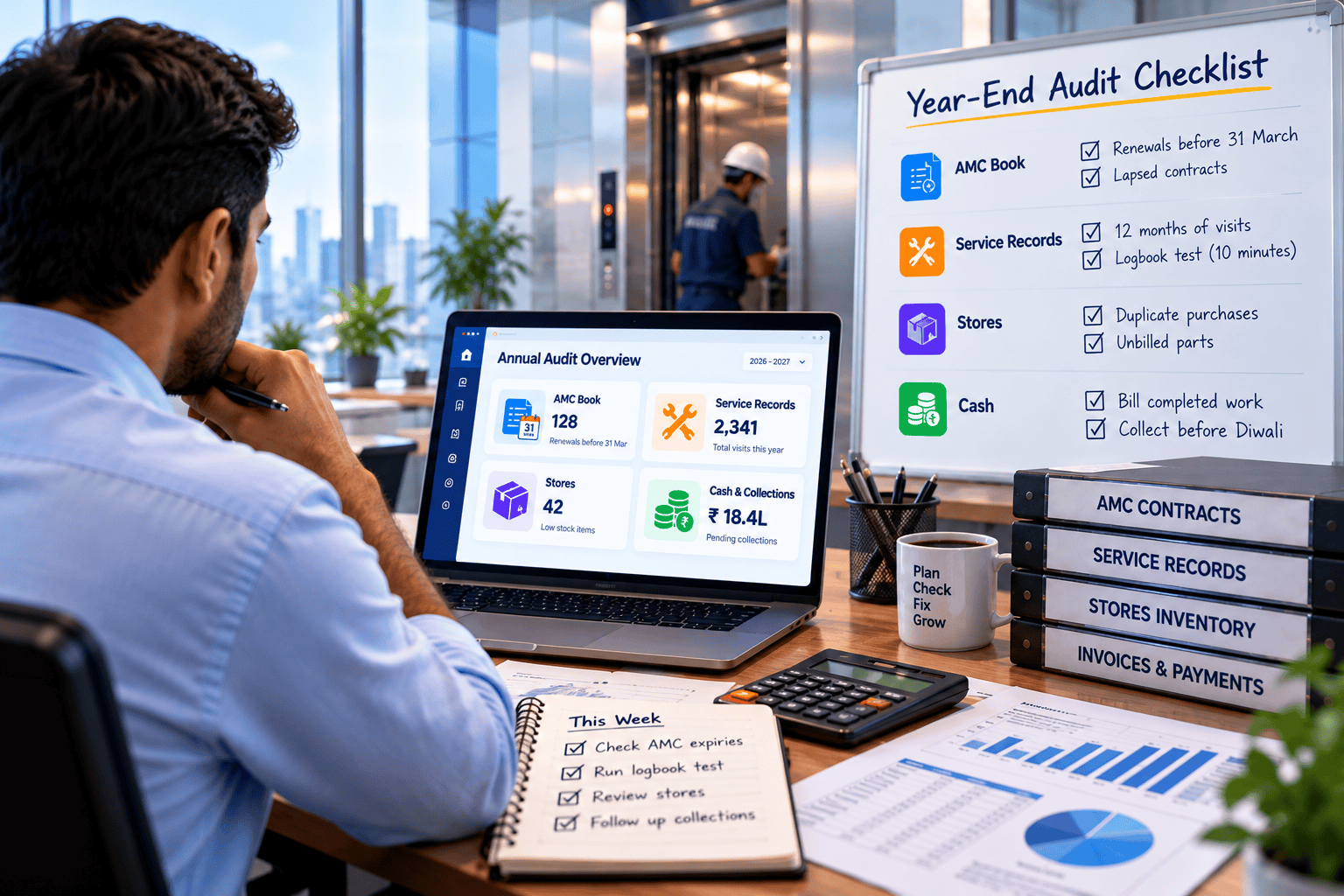
Week 1: Is your AMC book ready for 31 March?
The AMC book is your recurring revenue. The audit question is not "how many contracts do we have". It is "how many end before 31 March, and has anyone spoken to those customers".
This week is about dates and renewals. It is not about what you are actually servicing under each contract. That is a separate audit, covered in The AMC Contract Audit: What Are You Servicing?. Run that one after this.
| Day | Task | Output |
|---|---|---|
| Monday | Export every active AMC with its start date, end date, lift count and annual value | One list, one row per contract |
| Tuesday | Filter contracts ending between today and 31 March | The renewal list for this financial year |
| Wednesday | Find contracts that ended in the last 12 months and were not renewed | The lapsed list |
| Thursday | Check each lapsed contract: are you still attending breakdowns there without a contract? | A list of unpaid service you are giving away |
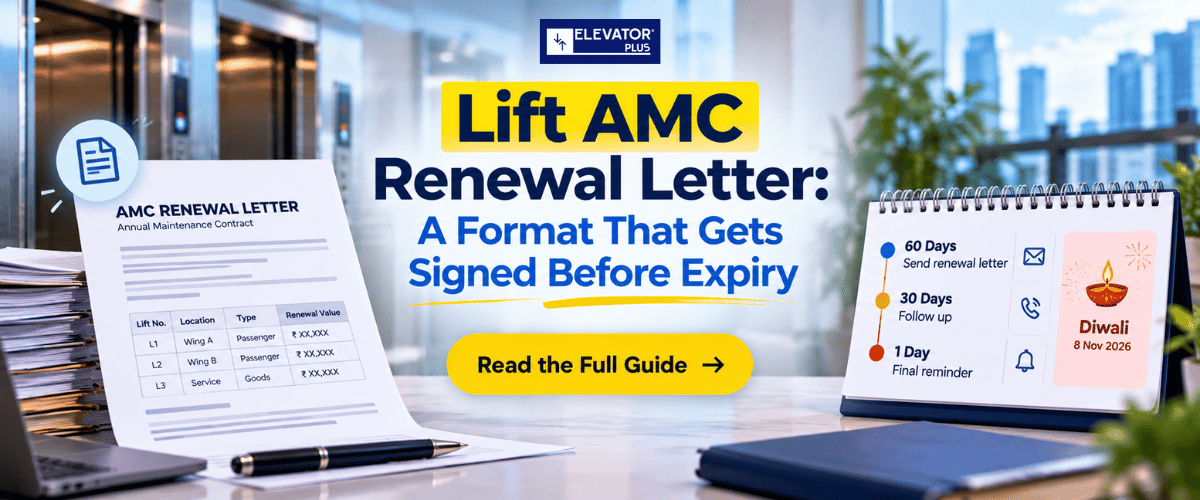
| Friday | Confirm a reminder is set at 60, 30 and 1 day before each expiry on the renewal list | No contract ends without three reminders |
| Saturday | Assign every renewal and every lapsed contract to a named person with a call date | Owner sign-off |
Thursday is the day most owners find something. A lapsed contract where your team still answers breakdown calls is service with no AMC behind it. Either bill it as chargeable work or renew the contract.
In ElevatorPlus, AMC management sends renewal reminders 60 days, 30 days and 1 day before expiry. If your reminders today live in a diary or one person's memory, Friday's task will show you how many contracts have none.
Week 2: Can you produce 12 months of visits on one lift in 10 minutes?
We call this the Logbook Test. Pick one lift at random. Ask your office for every preventive visit, every breakdown and every part fitted on that lift in the last 12 months. Start a timer.
If the answer arrives in 10 minutes, complete and in one place, you pass. If it needs a phone call to a technician, a WhatsApp search and a register from a site cabin, you fail. Most of the records probably exist. They cannot be produced as a set.
Why this matters goes beyond tidiness. The 2026 Supreme Court judgment concerned a lift death in 2003. The court noted that the contractor "produced no attendance register, duty chart, log book, or other contemporaneous record". Its own contract had required those records. The court said their absence "does not assist its case". The accident was in 2003 and the judgment in 2026. On our arithmetic, a record written this month may be read 23 years from now.
| Day | Task | Output |
|---|---|---|
| Monday | Pick five lifts: one from each branch or area, plus your oldest AMC | The test sample |
| Tuesday | Run the Logbook Test on all five. Time each one | Five times, pass or fail |
| Wednesday | For each failure, list where the missing records actually are | A map of where records live |
| Thursday | Check every record has date, technician, work done, parts used and customer sign-off | A gap list by field |
| Friday | Check what your state requires, if anything, for a per-lift log book | Your legal floor, by state |
| Saturday | Decide one change to how visits are recorded from 1 November | Owner sign-off |
Friday matters because states differ. Maharashtra, Karnataka and Tamil Nadu have a per-lift log book duty. Delhi and Kerala do not. Telangana has no lift Act in force at all. The state-by-state position is in Elevator Maintenance Records in India: What You Must Keep.
👉 Would your team pass the Logbook Test on a lift picked at random today? See how AMC visits and reminders are tracked in ElevatorPlus →
Week 3: Where are your stores losing money?
Stores leak margin quietly. Nobody steals anything. Parts simply get bought twice, fitted and forgotten, or sit in a van for a year.
Two leaks are worth a full week. The first is the same spare bought by two branches within weeks of each other, because neither could see the other's stock. The second is a part fitted on site that never made it onto an invoice. On a chargeable job, that is lost revenue. On an AMC, it is a cost you may not have priced for.
| Day | Task | Output |
|---|---|---|
| Monday | Pull every spare purchase since 1 April, by branch | One purchase list |
| Tuesday | Match purchases of the same part number across branches within 60 days | The bought-twice list |
| Wednesday | Pull every part issued to a technician since 1 April | The issue list |
| Thursday | Match each issued part to a job and an invoice, or to an AMC that covers it | The fitted-not-billed list |
| Friday | Physically count the 20 parts you buy most, in stores and in vans | Count against the book |
| Saturday | Raise invoices for chargeable parts found on Thursday, where still billable | Owner sign-off |
Thursday's match is the hard one. If a part was issued and you cannot say where it went, that is the finding. Our longer read on this is Elevator Inventory Software: The Three Ways Spares Leak Margin.
Inventory management in ElevatorPlus keeps stock for every store and branch in the same system as service jobs. Supplier purchases are entered as they arrive. Parts are issued to a technician against a specific job or lift. Low-stock alerts flag a reorder before a branch buys blind, and the stock valuation report gives you Friday's number without a separate spreadsheet. That turns Tuesday, Thursday and Friday from a spreadsheet week into a report.
Week 4: How much cash is sitting in work you have not billed?
Cash is the last week because the first three weeks feed it. Lapsed contracts from Week 1, chargeable parts from Week 3 and completed repairs all become invoices here.
Start with work done and not billed. It is the easiest money in the business to recover, because the customer already has the result. Then move to invoices raised and not paid.
| Day | Task | Output |
|---|---|---|
| Monday | List every job completed since 1 April with no invoice raised | The unbilled list |
| Tuesday | Raise invoices for everything on the unbilled list that is still billable | Invoices out |
| Wednesday | List every unpaid invoice older than 30 days, by customer | The collections list |
| Thursday | Call the 10 largest unpaid balances. Agree a date before Diwali | Promised dates |
| Friday | Send a written statement to every customer on the collections list | Statements out |
| Saturday | Record every promise and every refusal against the customer | Owner sign-off |
Diwali falls on 8 November 2026. If your calls go out in the last week of October, they land while customers are closing their own books for the festival. If they go out after Diwali, expect to wait.
Payment management in ElevatorPlus logs every payment received and the next due date against each customer and contract, and reminds your team when a collection follow-up is due. The invoice itself stays in whatever invoicing or accounting software you already run. For standard Tally there is a live add-on: bank names and suppliers sync from Tally, company details stay consistent, and a payment logged in ElevatorPlus creates a receipt entry in Tally (invoices themselves are not synced). Other platforms connect through our open API. For the detailed collection playbook, see Elevator AMC Collections: Stop Unpaid Invoices 2026.
What does a lift company audit look like when it is finished?
After four weeks you should hold six lists. Renewals due before 31 March, lapsed contracts, Logbook Test results, spares bought twice, parts fitted and not billed, and promised payment dates. Each list has an owner and a date.
If any list took more than a day to build, that is the real finding. The audit is not hard because the business is badly run. It is hard because the information sits in five places. Fix that, and next year's audit takes a week, not a month.
Frequently asked questions
1. What should a lift company audit cover?
Four areas: the AMC book, service records, stores and cash. Each can be run as a one-week checklist by one owner.
2. When should a lift company run its year-end audit?
In October and November. That leaves time to renew AMCs ending before 31 March and to collect before Diwali.
3. What is the Logbook Test?
Pick one lift and ask for every visit, breakdown and part fitted in the last 12 months. If your team cannot produce it complete in 10 minutes, the records are not usable.
4. How early should AMC renewal reminders go out?
ElevatorPlus sends renewal reminders 60 days, 30 days and 1 day before expiry. Contracts ending before 31 March should have a renewal call booked now.
5. How do lift companies lose money in stores?
Mainly through spares bought twice by different branches, and parts fitted on site that never reach an invoice.
6. Why collect before Diwali?
Diwali falls on 8 November 2026. A collection call made before the festival is easier than one made after it.
7. Is this the same as an AMC contract audit?
No. This audit covers AMC dates and renewals. The AMC contract audit checks what you are actually servicing under each contract.
📲 Join our WhatsApp channel for compliance tips, updates: ElevatorPlus - Business Automation Tool
Expect to find money in this audit. Not because anyone did anything wrong, but because AMC dates, visit records, stores and invoices sit in different places and nobody looks at them together until March.
Run the four weeks now. October gives you time to act on what you find. March only gives you time to explain it.
The order matters. AMC first, because renewals take longest. Records second, because they protect you. Stores third, because they feed the invoices. Cash last, before Diwali.
👉 Find out where your AMC book and stores are leaking. Book the Revenue Leak Walk-Through →
Related reading
- The AMC Contract Audit: What Are You Servicing?
- Elevator Maintenance Records in India: What You Must Keep
- Elevator AMC Collections: Stop Unpaid Invoices 2026
- Elevator Inventory Software: The Three Ways Spares Leak Margin
About the author. Mr. Sumeet Katariya is the founder of ElevatorPlus, the Elevator Business Operating System used by 200+ elevator companies across 20+ countries.
Sources: Supreme Court of India, 2026 INSC 756, 29 July 2026. · State lift Acts and Rules as read by ElevatorPlus, September 2026. · Drawn from ElevatorPlus onboarding work with 200+ elevator companies across 20+ countries.
👉 Follow ElevatorPlus on,
Instagram LinkedIn Facebook YouTube Qoura Substack Twitter